
Since its establishment in 2021, the QualiFAIR Hub has been working on increasing sharing and reuse of qualitative and context-sensitive data, making them more FAIR (Findable, Accessible, Interoperable, Reusable).
“Making data FAIR is important. It’s also required, which can be easy to forget,” says the Hub’s leader Professor Kirsti Klette.
The main aim of the hub is to develop good practices in research and administration that will support the FAIRness of qualitative data, that is non-numeric data that are often text, image, audio or video material.
A complex terrain
QualiFAIR’s mission spans across multiple domains, from infrastructure for data storage, to legal issues, to the cultures around data sharing in the academic community.
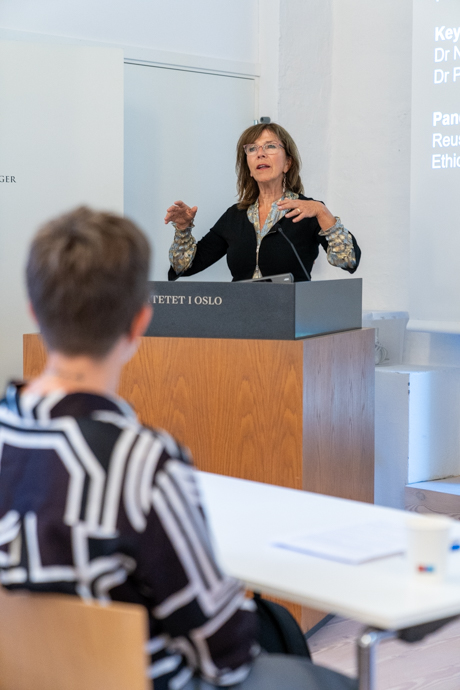
It’s a massive undertaking, but the Hub has managed to make good headway. Just talking about these issues across disciplines and professions is already a significant outcome, says the Hub’s leader Kirsti Klette.
“We were a little bit surprised, because it's kind of a niche subject, but we’ve consistently had 60 or more people at our breakfast seminars.”
Changing practices
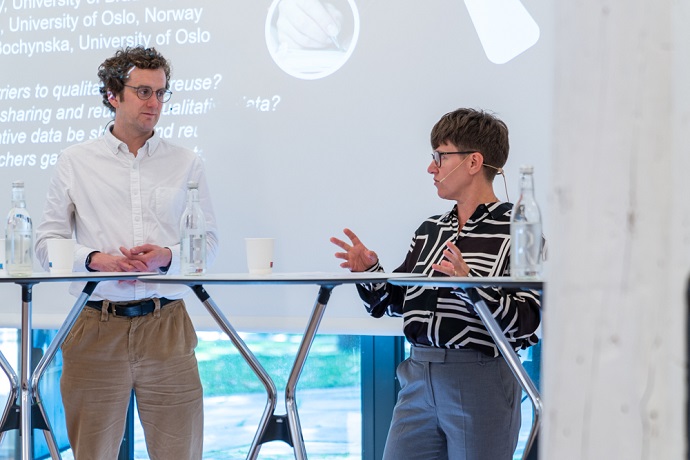
At the Hub’s final conference on September 12th, invited speakers discussed a range of issues related to qualitative data sharing.
Dr. Nicki Lisa Cole, a Senior Researcher in the Open and Reproducible Research Group at Know Center Research in Graz, Austria, highlighted that open science practices, rooted in quantitative research, often obstruct making qualitative data FAIR due to mismatched guidelines.
“I believe that open science has much to learn from qualitative research […] in terms of opening the research process, documentation practices, reflexivity, the centring of ethics, and the establishment of trust and rapport with participants.”
Cole views the QualiFAIR hub as a part of a parallel open science movement that tailors its practices to qualitative epistemologies and methods, says Cole.
Good habits
Good research habits and best practices for documentation and data gathering were emphasised throughout the conference.
Dr. Peter Branney, a psychologist at the University of Bradford, said that researchers need to think carefully about the level of processing the data needs in order to be sharable.
“Context and metadata are important to keep track of, because you might be able to do things to the data later that make it more sharable.”
QualiFAIR has been helping UiO researchers and staff increase the re-use of qualitative data through seminars and workshops. It has provided small grants for data preparation, used for example to hire research assistants to transcribe, code, and quality-check data, and to create metadata for better interoperability.
The Hub has also collaborated with organizations in Norway to push for changes in research training and infrastructure to address ethical and legal issues specific to qualitative research, such as data collection, anonymization, and controlled access to datasets.
Ethics and law
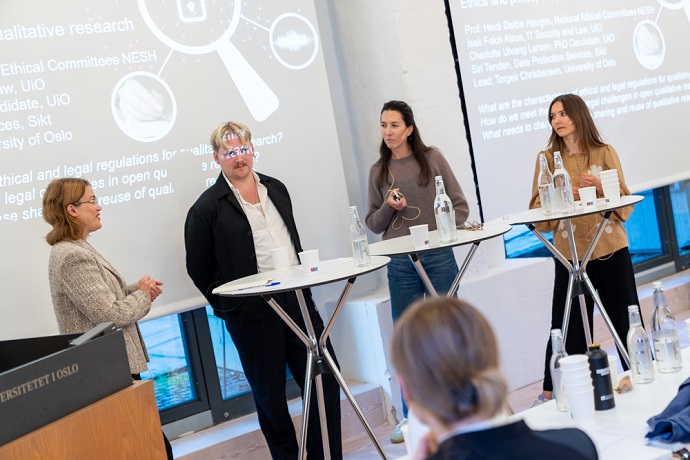
Torgeir Christensen, Chief Engineer from the Teaching and Learning Video Lab, has been closely involved in QualiFAIR. During his talk Christensen presented some advice to researchers about planning for data reuse at data collection stage.
“Using direct consent as legal basis for collecting personal data is very demanding because it is almost impossible to foresee ways that the data might be re-used in the future. Public interest as legal basis is a better option.”
Christensen also argued for establishing ethics committees, which are not traditionally part of the research infrastructure at Norwegian universities, to help researchers navigate ethical issues related to data collection and sharing.
On the topic of ethics committees, Heidi Haugen from National Committee for Research Ethics in the Social Sciences and the Humanities (NESH) said that,
“We have a unique situation in Norway where we don’t have ethical boards […] A disadvantage to this is that ethical considerations can be left too late or forgotten about. An advantage is that researchers do not think about ethics as something you get approval for and then forget about.”
Infrastructure
Several presenters at the conference discussed issues related to both short-term and long-term storage of research data. This is an area where QualiFAIR has been particularly active.
The infrastructure work package, led by Dr. Agata Bochynska, has been assessing currently used software and storage spaces for qualitative researchers at UiO.
The team sees a need for more collaboration-friendly, secure and scalable software and storage systems at UiO, as well as clearer guidelines in how to use existing infrastructures and better user training and support.
“For long-term data preservation and reuse, better archive solutions with access control are also urgently needed, both at UiO and nationally,” says Bochynska.
Advice to researchers
A key piece of advice echoed throughout the conference was to begin research projects with sharing and re-use in mind.
Retroactively making data FAIR is far more time consuming and ethically challenging than building a research project from the ground up with appropriate permissions, documentation and routines. For those that do plan a project with sharing and re-use in mind, there are resources and expertise for supporting researchers in this process both nationally and at UiO - among research administrators, technicians, and librarians.