Why education groups?
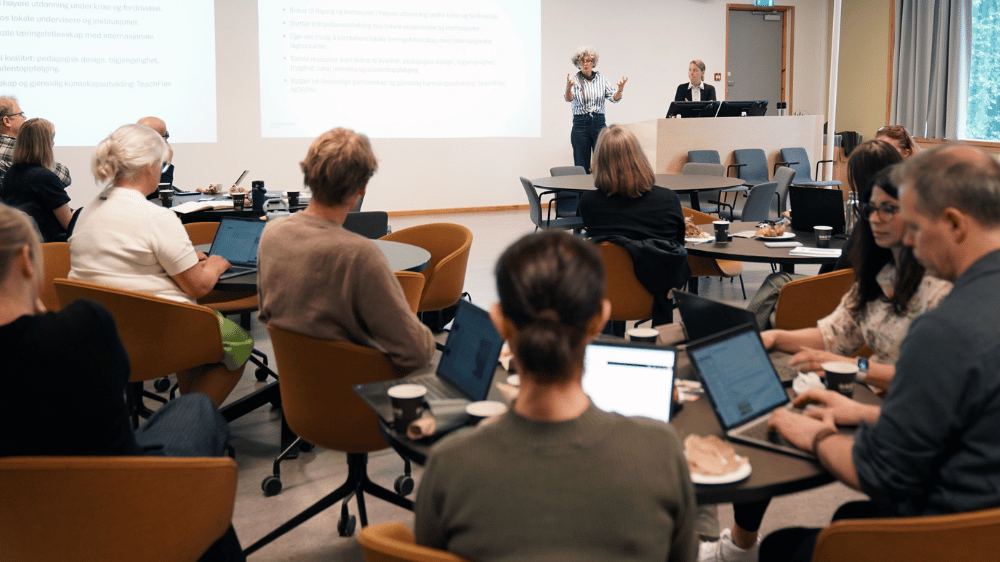
Traditionally, teaching in higher education has often been an individual task where one faces challenges and solutions alone. Through the education groups we make teaching a shared, collegial collaboration that contributes to collective competence development.
The faculty seeks to:
- Strengthen the quality of education: create more student-active, relevant and future-oriented teaching.
- Build a culture of sharing and development: establish an equal arena where academic staff, technical-administrative staff and students can explore and try out new ideas together.
- Make teaching work meritorious: provide space for systematic exploration and reflection that responds directly to the SoTL principles (Scholarship of Teaching and Learning) about collegial practice and pedagogical development.
How do the education groups work?
There is no standardized recipe for how an education group should work. The group owns its own process and way of working.
- Safe frameworks for sharing experiences: the group should be an arena for airing real challenges, discussing doubts and sharing both successes and missteps.
- Choose the working method that fits best: the groups choose how they organize themselves; whether it is regular peer-coaching coffee meetings, joint assignment development, testing new digital tools, or mutual observation of teaching.
- Research-based and exploratory approach: the group can be seen as a pedagogical workshop with a low threshold for trying out new teaching approaches or further developing existing teaching.
Who are the Education groups for?
The work the Educational Groups have three important recipients.
1. Members of the different Educational Groups
An Education Group is first and foremost important for those who participate. The group is intended to provide an academic community, which in turn contributes to individual competence development. It should create a safe framework for professional input, new perspectives and a space where you as an instructor do not have to face pedagogical challenges alone.
Participation supports the teacher's continuous professional development over time and promotes a research-based and exploratory approach to one’s own teaching. This aligns with the SoTL-principles (Scholarship of Teaching and Learning). In addition, an Education group provides a space to systematically reflect on one's own practice and students' learning in a collegial environment.
2. The academic environments at the Faculty of Educational Sciences
The Education Groups contribute to systematic academic development work. This aligns with the requirement in the Regulations for universities and university colleges that clarifies that academic environments must systematically work to improve and renew teaching, learning processes and academic content, based on research- or experience-based knowledge. The Education Groups give the faculty's academic environments a common and interdisciplinary arena to fulfill this requirement.
This also corresponds with the SoTL principles for collegial attitude and practice, where teaching and educational development are lifted from being an individual task to a common internal concern within the faculty.
3. The higher education sector and the surrounding community
A core principle in SoTL is that pedagogical insights, tested designs and experiences should be made publicly available so that colleagues outside the local environment can build on them.
The Education Groups' academic development work will be made available through the Teaching Library and is openly accessible to the whole higher education community.