
Interactive and Dynamic Collaboration Opportunities

Maximize creativity and collaboration with multiple groups working simultaneously. From digital screens to whiteboards, flexible workspaces allow groups to design their ideal working environment for better problem-solving and collaboration. This type of activity facilitates:
- Customized work environments where groups design and collaborate based on their needs.
- Groups' ability to work in parallel in defined areas for focused work and learning.
- Use of flexible tools such as movable partition walls with access to screens for media display, visualization, and ideation.
- Creative freedom with the ability to write and draw directly on walls and whiteboards.
Room and Activity Configuration
Collaborative group work allows students to share knowledge, develop problem-solving skills, and strengthen communication, promoting a deeper learning process.
Teacher Role and Room Setup
- Each group is responsible for designing and organizing their own work environment and using the necessary equipment and materials.
- The lecturer facilitates the use of resources when needed.
- The lecturer is mobile, supporting and guiding the students' group work.
- It is recommended to set aside 10-15 minutes to clean up the room after the activity if necessary.
- This activity requires that students are initially given time to form groups and create their own work environment.
How to:
- Introduce a relevant case, scenario, or problem that is pertinent to the course.
- Use case studies or real-life problems and let students apply their knowledge practically.
- Give students time to analyze the case and then lead a group discussion with guiding questions.
- Ask students to suggest solutions or actions based on their analysis.
- Summarize the key points and discuss possible real-life implications.
This type of activity promotes problem-solving, links theory to practice, and strengthens decision-making skills. Collaborative group work also encourages independence and autonomy.
Photo highlights

Seminar room 241 is the only room in Helga Engs hus that facilitates creative learning by allowing students to use the walls as a whiteboard surface. The room is also equipped with screens that can be used to draw, write, include digital participants or connect to different media.
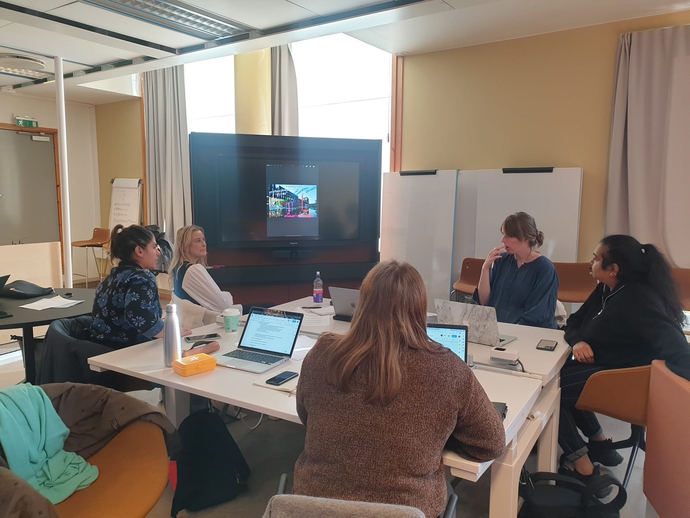
The room simplifies group learning and work with both traditional and digital solutions. Students can easily utilize various digital and tactile resources to support their learning. Additionally, hybrid participation can be facilitated via screens.
The room simplifies group learning and work with both traditional and digital solutions. Students can easily utilize various digital and tactile resources to support their learning. Additionally, hybrid participation can be facilitated via screens.
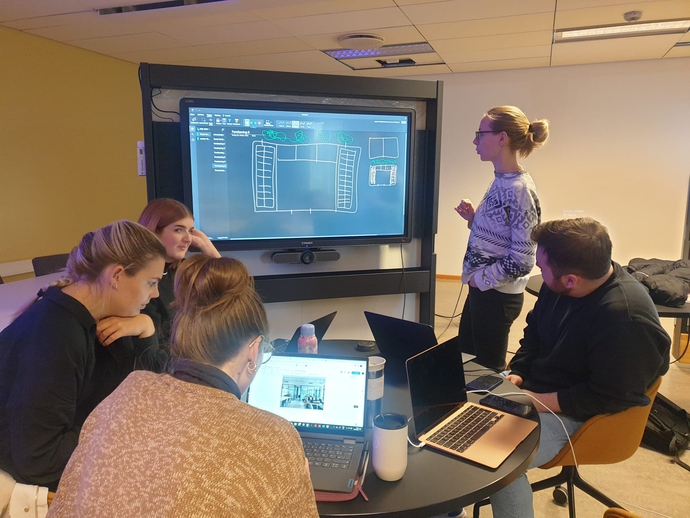
The room enables students to visualize their work using a variety of digital and tactile tools.