
Students Lead and Design Activities, Boosting Critical Thinking and Hands-On Learning
Encourage students to design, lead, and evaluate activities, enhancing their problem-solving and coordination skills. This hands-on approach promotes flexible learning and peer-driven insights. This activity type facilitates:
- Student groups testing planned activities for another group, where they lead, observe, and evaluate the session.
- Students thinking through how to plan the activity and coordinate with other groups to achieve maximum flexibility (based on experience).
- Planning and implementing their own teaching in practice, resulting in increased ownership of learning processes and gaining experience in facilitating diversity and communication.
Room and Activity Configuration

Student-led activities promote responsibility, collaboration, and engagement, providing students with valuable leadership and communication experiences.
Teacher Role and Room Setup
- Students are the main contributors and conduct the activity. The lecturer assists in organizing the room and the activity, especially when changing groups.
- The lecturer acts as a timekeeper and provides support during the activity.
- The lecturer observes group discussions and provides guidance as needed.
- The lecturer facilitates students' reflection after the activity.
- It is recommended to set aside 10-15 minutes to clean up the room after the activity.
- The activity requires students to review course material prior to the meeting to utilize meeting time for practical applications and discussions.
How to:
- Assign pre-class materials such as readings, videos, or recorded lectures to be completed before the session.
- Use tools like Mentimeter, quiz functions in Canvas, or small group discussions to gauge understanding at the beginning of class. Activities like debates, case discussions, or hands-on exercises based on pre-class material can also be used.
- End with a reflection on what was learned and clarify any questions.
This activity type encourages student autonomy and reflection while maximizing in-class engagement and strengthening comprehension.
Photo highlights

Seminar room 241 is designed to empower students to take active control of their learning and explore innovative ways of working. The room can be easily divided into different zones for various activities. A focus on visual interpretation and universal design ensures that all students have equal opportunities to participate.

The room is spacious, adaptable, and well-equipped, making it easy to conduct student-led activities for the entire class, going beyond traditional teaching methods.
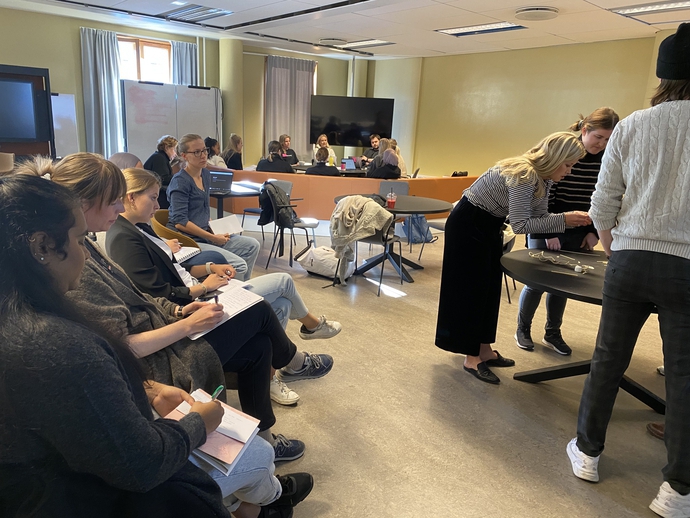
Movable modules, chairs, tables, screens, projectors, and cameras make it easy for both physical and digital participants to follow the teaching and engage in activities.