World café
World Café is a working method for initiating dialogue and collaboration. The participants move between different tables where they discuss and share experiences. Café dialogues can be carried out with or without AI as a collaboration partner.
World café briefly explained
A method where participants:
- sit in small groups (often 4–6 people),
- discuss a common question for a short period of time,
- change tables several times,
- and gradually build on each other’s contributions.
The goal is for each conversation to build on the previous one, and for everyone to experience a meaningful, inclusive, and exploratory dialogue.

Why world café?
World café can promote student-active, open, and exploratory dialogue. The method is particularly suitable for new, debated, and/or normative topics such as the use of artificial intelligence. With good preparation, World Café can provide space for the exploration of attitudes, experiences, and dilemmas, and it can support learning through the social construction of knowledge. The main goal of the dialogue will primarily be to stimulate reflection, and not necessarily to find a definitive right or wrong answer.
The method is inspired by conversations in cafés – relaxed, open, and dialogue-based, but with a clear structure. The purpose is to create a shared learning process where ideas develop over time and across groups.
How does world café work?
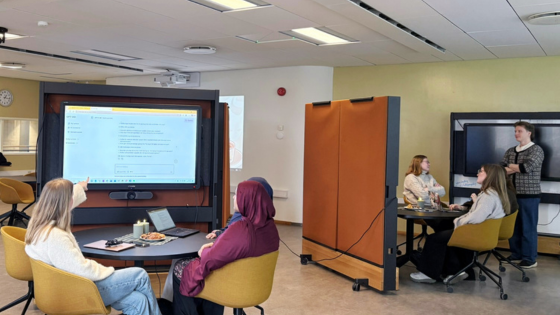
The activity can be adapted to your course as you wish. In our case, the students are divided into groups of 3 – 6, sitting at separate tables. A host at each table is responsible for keeping the conversation going and noting the main points along the way (the table host). The discussion usually lasts around 15 – 20 minutes and focuses on a specific topic relevant to the course. In this case, the students are discussing guidelines for use of AI in the course.
After each discussion round, participants move to new tables. The table host stays behind and shares the main ideas from the previous discussion with the new participants. The new group can both build on the discussion from the previous group, or add new points. The process is repeated for several rounds, preferably with new questions so that participants can build on previous dialogues.
After the small group discussions, all participants gather for a plenary discussion. Here, the hosts can summarize the most important ideas that have emerged during the conversations. It is important to take notes along the way, and the results should be shared and followed up further.
You can use students, teaching assistants, ph.d candidates, or other seminar leaders as café hosts.
Preparations
Part of the concept of café dialogue is to create a safe and inviting atmosphere for open dialogue.
Prepare the room

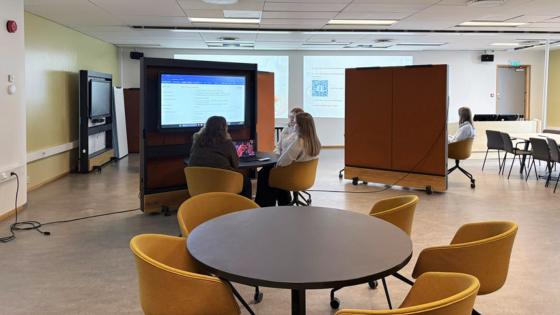
Set aside some time to transform the room into an improvised café before the seminar. This can easily be done by using tablecloths/napkins on the tables, battery-powered lights, and by offering the students coffee, fruit, cookies or similar. If you have time, you can also send out a particularly nice invitation to the café dialogue.
The room must be large enough for students to move easily between the tables without disturbing each other during discussions. An example is room 241 in Helga Eng’s building, where you can also create zones with the movable partition walls.
Prepare the students
It may be wise for the students to come somewhat prepared, so that they have some idea of what café dialogue is about. Therefore, feel free to post information in Canvas about what café dialogue is, as well as recommended literature, well in advance of the seminar.
Suggested reading before the seminar
- Brown, & Isaacs, D. (2005). The World Café: shaping our futures through conversations that matter (1st ed.). Berrett-Koehler Publishers. (Introduction chapter pp. 1–11 and chapter 12 pp. 196–211)
- Mercer, N. (2013). The social brain, language, and goal-directed collective thinking: A social conception of cognition and its implications for understanding how we think, teach, and learn. Educational Psychologist, 48(3), 148–168.
Execution
- 10 – 15 min: Introduction
- 1 – 2 hours: world café
- 30 – 45 min: Reflection tasks and summary
Table hosts
- Student as the table host: a student, teaching assistant or seminar leader sits at each table and is responsible for starting and summarizing the discussions.
- AI as the table host: carried out with UiO GPT and a pre-programmed AI assistant. The students use the dictaphone app and upload the transcript to the Cafébot – which starts and summarizes the discussions.
Suggested café tasks
- Traffic light activities (see examples and explanation)
- Open reflection tasks
Concluding reflection tasks
Experiences and suggestions can be used as a starting point for further discussion and/or the development of guidelines for AI use in your course.
Alternative 1: Whole-class discussion
Each group presents some main points/issues/suggestions to the rest of the class. Here you can also use Talkwall (Samtavla), where students can share discussion points, experiences and suggestions for AI guidelines with the rest of the students.
Alternative 2: Summary of the groups’ discussions recorded and submitted in Canvas
The students distribute roles for the final activity of the day into four roles:
- Summarizes the day’s activities briefly
- Manages time and discussion points
- Records the conversation, either by using the dictaphone function in Word or by making an audio recording using the Nettskjema Diktafon-app
- Writes up the conversation and uploads it to a dedicated submission space in Canvas
When the roles have been assigned and the audio recorder has been started, the discussion begins. The discussion should last no more than 10 minutes, and everyone must participate in the discussion.
Suggested discussion points
- What have we done/learned today, and how?
- Was there anything we did not understand or would like to learn more about?
- What challenges did we encounter, and how did we solve them?
- Suggestions for guidelines for AI use in the course?