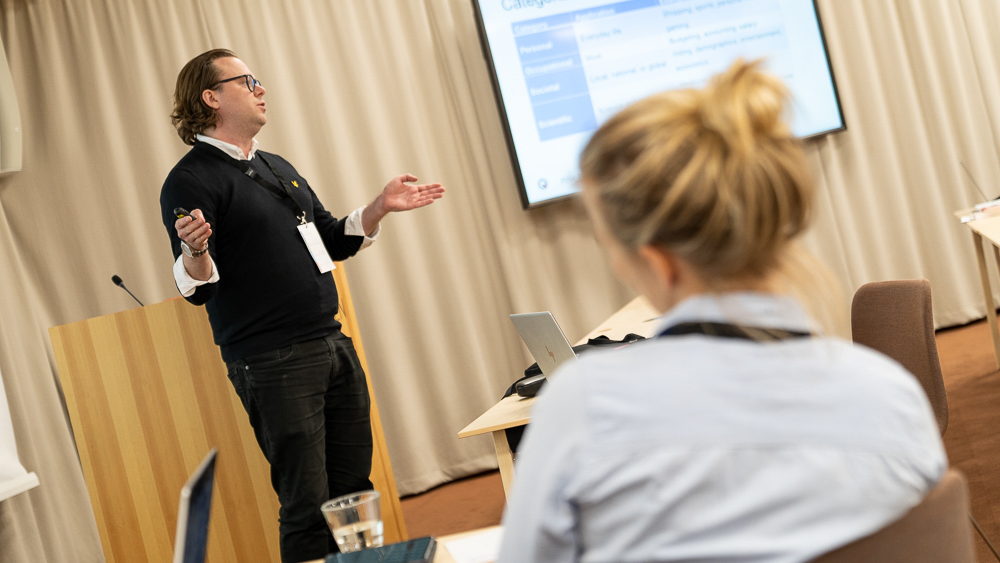
Alexander Jonas Viktor Selling has researched how mathematics teachers set goals for junior high school students in the Nordic countries.
“I was interested in teachers' use of goals since it is often referred to as an important practice, while at the same time there is relatively little research that says anything about what type of goals are set and how clear they are” says Selling.
Why is it important to set goals?
In order for pupils to understand both why and how they should learn mathematics in the first place, setting clear goals is a vital practice, says Selling.
“Goal setting clarifies what the pupils should be learning, which helps them gain an insight into the teacher's expectations. This can help make the purpose of the lesson clearer.

“Goals are also important for letting students know why they should learn something, why a given topic is important.”
Teachers' goals
“In my research I’ve found that the goals during teaching are often vague and mainly focus on pure mathematical content, rarely on mathematical processes and applications.
Selling says that goals that focus on purely mathematical content can obscure the purpose of a lesson.
“I also found that the goals are rarely highlighted during or at the end of a lesson, which is an important teaching practice linked to goals.”
Selling's results show that most of the tasks involved few opportunities for pupils to develop their mathematical competence.
“Goals are also important for letting students know why they should learn something, why a given topic is important.”
Rare insight into the Nordic classroom
Selling used 146 hours of videotaped of lessons from 48 mathematics classrooms in the at secondary level in the Nordic countries. The videos were filmed as part of the LISA-Nordic study at the QUINT Centre, where Selling is a PhD Fellow.
“When I wrote my master's thesis, I started to look at teachers' use of goals in Norway. When I got the chance to do a PhD in the LISA Nordic project, I wanted to do further research on this. I also wanted to expand my scope by looking at how different types of goals can be highlighted indirectly in teaching, for example through tasks, which are often a central part of mathematics teaching.”
The dream is to become a professor
Now that Selling is about to defend his thesis, he reflects on what it is like to do research on teaching.
“I think it’s interesting to research teaching and teacher training. I hope that my work has contributed to the understanding of what goal setting looks like in Nordic classrooms, especially with regard to how to strengthen this practice.”
When asked about his ambitions for the future, Selling says
“I hope to be able to continue with school research and teacher training in the future.
“My dream job would probably have to be professor of mathematics didactics.”