
About the Project
English occupies a unique position in Norway because children are exposed to English from an early age through school, media, and everyday life, resulting in relatively high levels of English proficiency compared with many other EFL contexts (Hellekjær, 2009; Rindal & Brevik, 2019). That said, academic vocabulary remains challenging even for advanced L2 learners, and explicit instruction that builds on existing proficiency may continue to support vocabulary development (Webb & Nation, 2017; Schmitt, 2008).
This project presents a new vocabulary intervention based on the idea that students’ existing knowledge of both languages can be used as a resource for learning. Instead of treating English and Norwegian as separate systems, the project explores how bilingual knowledge can support richer vocabulary learning and metalinguistic awareness.
Language Links
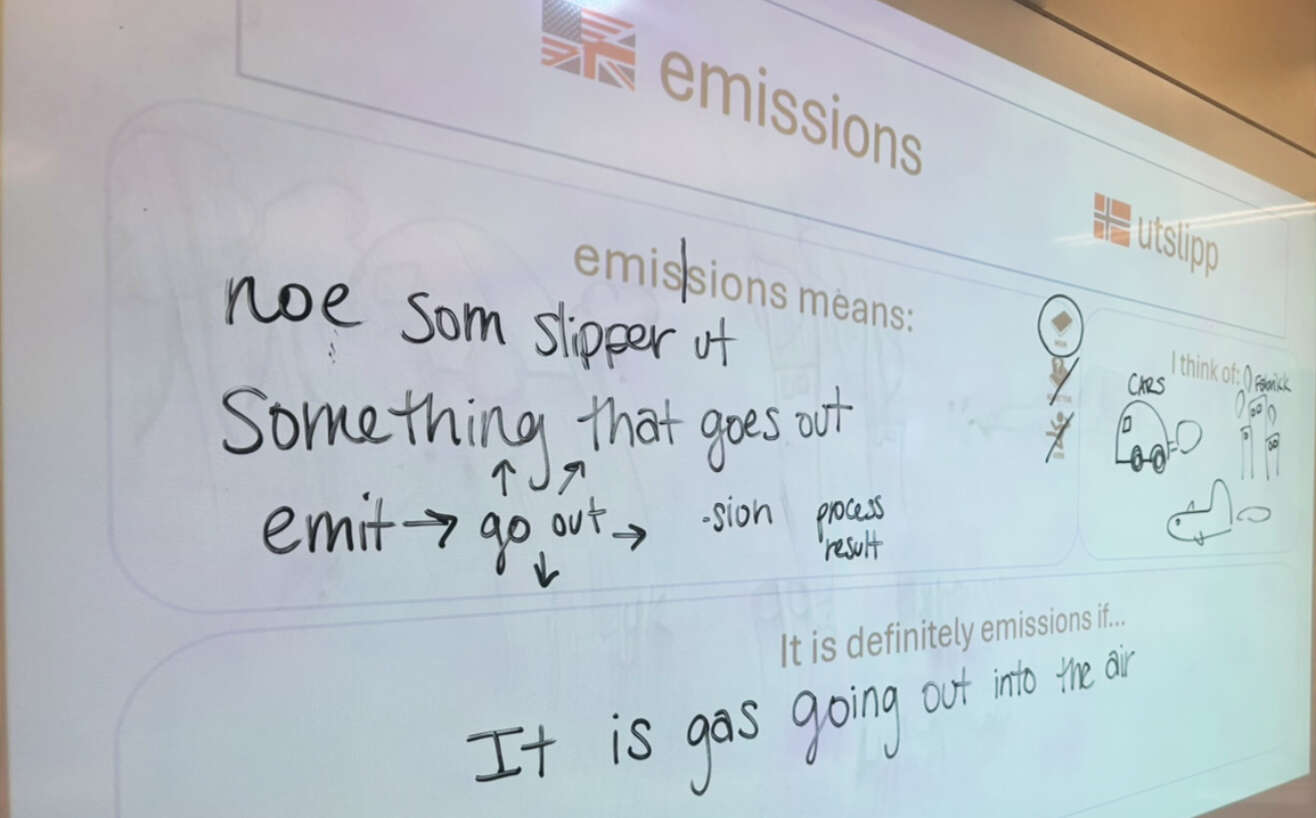
The vocabulary intervention for Norwegian 6th grade students spans two weeks, meeting for one hour per day, four days per week. Students learn six academic English words related to environmental topics and their Norwegian translations. In the first week, students receive explicit instruction in word meaning and the morphology of both the English and Norwegian words. They complete structured word maps and engage in collaborative vocabulary activities alongside classroom discussion with a native English-speaking teacher. In the second week, students compare English-Norwegian translation pairs, exploring similarities and differences in meaning when translations are not exact equivalents.
Goals
The goal of this project is to investigate whether explicit vocabulary instruction that integrates morphology training, bilingual comparison, metalinguistic reflection, and deliberate translanguaging can strengthen students’ vocabulary knowledge and metalinguistic awareness.
More broadly, the project aims to explore how students’ existing bilingual proficiency can be used to support language learning and to inform evidence-based approaches to second language teaching when learners already have relatively high proficiency.