TeamLearn
Teamwork analytics for training collaborative problem solving in professional higher education
Duration
01.12.2021–30.11.2026
TeamLearn studies how digital technologies, multimodal learning analytics and automated feedback can be employed to study collaborative problem solving and team-based learning in higher education.
Student teams from medical interprofessional, nursing and legal education are studied while they solve complex problems, for example, a patient diagnosis, a critical intensive care situation or an ill-defined complex legal problem.
The project uses design-based research and develops multimodal learning analytics dashboards (MAD), which visualizes multimodal data (e.g. micro-location sensors, audio, video, object use logs, text) as feedback on the team activities. The feedback is shared with students and teachers in interventions aimed at supporting collaborative problem solving and team-based learning.
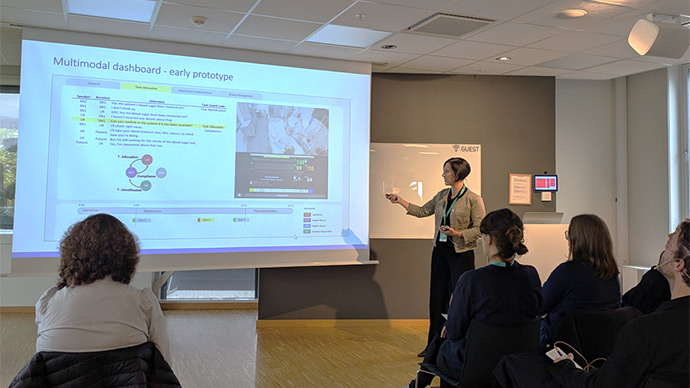
Crina Damsa presents the Multimodal Learning Analytics Dashboard (MAD) in a lecture at the University of Oslo. Photo: Gina Paola Carrillo
Objectives
The project has four objectives
Develop methodologies and indicators for the real-time feedback and guidance of teamwork in collaborative problem solving in professional education;
Adapt, test, and implement a learning tool for providing automated feedback based on multimodal analytics on teamwork during learning collaborative problem solving;
Generate knowledge about the effects of interventions and learning designs based on multimodal teamwork analytics on the collaborative problem-solving process and outcomes;
Develop and disseminate knowledge and instruments based on multimodal teamwork analytics to support collaborative problem-solving and teamwork across professional education contexts.
Background
The project combines learning research, computer sciences and learning analytics, and includes Norwegian partners and collaboration with universities from Australia, USA, Finland and the Netherlands.
Research design
Phases
The project has four phases
Phase 1: We gather insights from stakeholders about their experiences and support needs related to teamwork and collaborative problem solving.
Phase 2: We co-design and pilot a multimodal teamwork analytics dashboard in three higher education courses. Researchers and teachers develop learning scenarios where the dashboard provides feedback to support students’ collaboration.
Phase 3: We conduct formative interventions to impact on team collaboration and performance, and collect data to document qualitative effects.
Phase 4: We carry out dissemination and exploitation activities to share results and promote broader use of the tools and findings.
Empirical Cases
Case 1. Medical Interprofessional Education
Students from various disciplines (medicine, psychology, nutrition, pharmacy, theology, pedagogy, and dentistry) engage in realistic simulations of sub-acute patient assessments. The data about team interactions and interaction with patients is visualized and used in data-supported reflection sessions with the students.
Case 2. Simulation in Nursing Education
Nursing students participate in high-fidelity acute care simulations. The multimodal analytics dashboard integrate video and physiological data to highlight key teamwork dynamics, such as closed-loop communication, task and role distribution, and stress responses, to support debriefing after the simulations.
Case 3. Legal Technology and AI in Law Education
Law students work in teams to solve open-ended legal problems using AI and technology. Groups of students collaborate in hybrid seminars and project work, addressing legal, ethical, and technological issues. The multimodal analytics dashboard providessupport reflection on collaboration by providing meeting, document and collaborative process analytics.
Sánchez, D., Damşa, C., & Heyn, L., (under review). Collaborative sense-making of simulation events: A micro-ecological approach using multimodal data, Special issues in Learning and Instruction
Kaliisa, R., Eagan, B., Damşa, C., & Misiejuk, K. (under review). How Did TeamLearn—an AI-Supported Multimodal Dashboard—Impact Students’ Reflection During Collaborative Problem-Solving? Findings from a Three-Iteration Design Study, Special issues in Learning and Instruction
Kaliisa, R., Eagan, B., Damşa, C., & Misiejuk, K. (under review). How Did TeamLearn—an AI-Supported Multimodal Dashboard—Impact Students’ Reflection During Collaborative Problem-Solving?, British Journal of Educational Technology
Sánchez, D. & Kaliisa, R. (under review). Multimodal analytics dashboards to support reflection in high-fidelity nursing education, Journal of Learning Analytics
Kaliisa, R., Esterhazy, R., Damşa, C., Sánchez, D. (in progress). An analytical framework for collaborative problem solving.
Damşa, C., & Heyn, L., Johansen, E.A., Wesenberg, E.L, Eide, H., Sanchez, D., Esterhazy, R. & Louwerens, C. (in progress). Challenging the standards of simulation: Designs for multimodal data-supported debriefing in high-fidelity in simulations.
Esterhazy, R., Brouwer, J., Damşa, C., (in progress). Leadership in teams in interprofessional education.
Esterhazy, R., Wøien, H. Mathiesen, L., Damşa, C. (in progress). Pedagogical and technological designs for supporting interprofessional collaborative learning.
Damşa, C., Esterhazy, R., Dolonen, J.A., & Karlgren, K. (in progress). AI-supported coding of multimodal interaction data.
Papers in conference proceedings
Kaliisa, R., Damşa, C., et al. (2026) TeamLearn: A Multimodal, AI-enhanced Dashboard for Reflection During Collaborative Problem-Solving, Proceedings of the Anual Meeting of the International Society of the Learning Sciences, Irvine, CA, US.
Kaliisa, R., Damşa, C., Misiejuk, K., & Eagan, B. (2025, June). Understanding the impact of physical, online, and hybrid modalities on self and co-regulation during collaborative problem solving. Paper presented at the ISLS Annual Meeting, Helsinki, Finland.
Sánchez, D., Kaliisa, R., Esterhazy, R., & Damsa, C. (2024). Unpacking the Elicitation Process for Multimodal Learning Analytics based Feedback. Companion Proceedings 14th International Conference on Learning Analytics & Knowledge (LAK24), Kyoto, Japan.
Presentations in international and national conferences
Sanchez, Daniel; Damsa, Crina I.; Carrillo, Gina Paola; Heyn, Lena & Olesen, Susanne (2026). Multimodal Data-supported Debriefing: Enabling collaborative sense-making through video, transcripts and physiological data in Nursing education, 31st Annual Meeting of the Society for Simulation in Europe (SESAM 2026)
Kaliisa, Rogers; Mladenovici, Velibor; Damsa, Crina (2026). Rethinking Learning and Collaboration in the Age of Generative AI, Paper presentation at the EARLi SIG4 & 11 conference, Helsinki, Finland.
Damşa, C. (2023). Keynote presentation: Understanding and teaching collaborative learning, Learning conference, University of Bergen
Crina Damsa, Rachelle Esterhazy, Daniel Sanchez, Rogers Kaliisa (2024, December). Teamwork analytics for training collaborative problem solving in professional higher education, USN Research forum
Crina Damsa, Rachelle Esterhazy, Daniel Sanchez, Rogers Kaliisa , TeamLearn (2024, May). Teamwork analytics for training collaborative problem solving in professional higher education, USN konferanse.
Crina Damsa, Rachelle Esterhazy, Daniel Sanchez, Rogers Kaliisa (2023, October). TeamLearn - Forskningsprosjekt om læringsanalyse som verktøy i problemløsning og teamarbeid i profesjonsutdanning, Nettverksmøte for Helsefaglig Simulering i Helse Sør-Øst
Crina Damsa, Rachelle Esterhazy, Daniel Sanchez, Rogers Kaliisa (2022, October), Samarbeidslæring –pedagogiske prinsipper med relevans for tverrprofesjonelt arbeid og utdanning
Susanne Olesen, Edda A. Johansen, Lena Heyn (2022). Simulation based training with data-driven feedback for ICU nurse students, SimPro2024, The Fourth International Conference on Analyzing practices and advancing pedagogies for professional Learning.