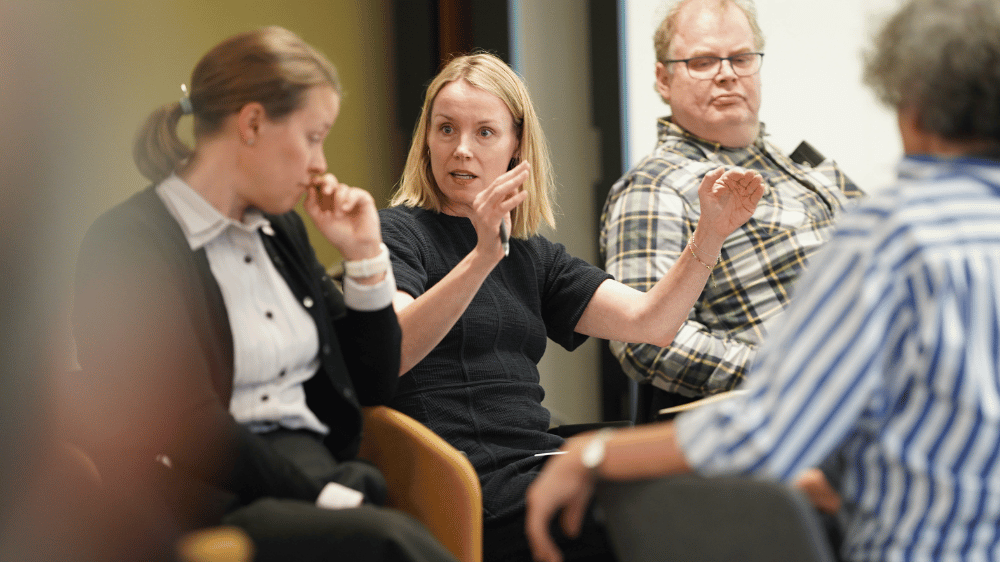
Sharing experiences between the groups
Tuesday, 6 October 2026 the Educational Groups met for a sharing seminar to exchange experiences about how the different groups have organized themselves. The experience is that the various groups have chosen a rich diversity of different working methods, and everyone is very satisfied with their own organization.
Open classrooms and collegial observation
The education group HUB (Higher Education and Sustainability) has organized itself as an interdisciplinary community where teachers from all three institutes at the faculty, in active collaboration with students, explore sustainability perspectives. The core of the working method is mutual teaching visits with an emphasis on collegial guidance. Through observation, professional conversations and joint reflection they further develop teaching practice together – with the overarching goal of integrating and strengthening sustainability perspectives in the faculty's courses and teaching.
Workshop-based co-creation and thematic subgroups
Through regular, in-person workshops and smaller working groups, HybriFlex brings teachers together to explore how hybrid and flexible teaching can make study programs more accessible and student-active. Participants meet to share their own experiences and teaching designs, before delving into specific topics ranging from practice supervision to pedagogical crisis preparedness. The goal is to develop a consolidated resource module for the benefit of the entire faculty and international partners.
Regular meetings in the form of an academic study circle
Organized as a focused and closely-knit academic study circle, LIS (Reading in Studies) meets twice a month to increase knowledge about students' reading and disciplinary text comprehension. The group immerses itself in academic literature, invites guests from the library and other academic environments for professional presentations, and directly translates the insights into testing concrete reading measures and pedagogical scaffolding in their own courses at both bachelor and master's levels.
Methodical design and research-based testing
Through a stepwise and exploratory process grounded in Design-Based Teaching, KIVU (AI and Assessment in Education) works to further develop assessment forms in light of artificial intelligence. The group will first establish a common knowledge base about new research and practice in the field, and then design 4–5 authentic assessment cases to be tested in real, different courses. The experiences will then be shared.
Virtual skills training for challenging teaching situations
With participants from various academic environments, the TLV lab and the practice field, the education group Videosimulering brings together different expertise to give students safe practice of challenging teaching situations. The group collaborates to develop realistic scenarios that are filmed with 360-degree cameras. This allows students, using VR headsets, to practice classroom management and relationship handling in a simulated and safe environment.
Highlights from the seminar
Teaching library for sharing practices
The Educational Groups are now continuing to work on their focus areas. The groups' findings and experiences will gradually be shared in the Teaching Library so that as many people as possible can take part in the groups' experiences.