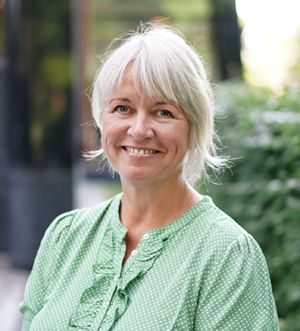
Faglige interesser
Lærerens og lærerstudentens profesjonsfaglige digitale kompetanse (PfDK). Digital dømmekraft og digital livsmestring. Digitale skiller. Komparativ og internasjonal utdanningsforskning.
Undervisning
Merittert utdanner 2023 - medlem av Pedagogisk akademi
Forelesninger om digital dømmekraft på PPU3520d, PPU3220, PROF3025
PPU 3510d Pedagogisk seminar
PPU 3520d Pedagogisk seminar
PHUV9110 Theory of Knowledge in Teacher Education Research
PHUV9100 Philosophy of Science, Research Methodology and Ethics
Intercultural Competency in Education
Bakgrunn
Utdanning:
- PhD komparativ og internasjonal utdanning, IPED, Universitetet i Oslo (2011)
- Master i komparativ og internasjonal utdanning, IPED, Universitetet i Oslo (2002)
- IKT støttet læring, Universitetet på Island (2000)
- Praktisk pedagogisk utdanning, Universitetet på Island (1993)
- Bachelor i sosialantropologi, Universitetet på Island (1992)
Arbeidserfaring:
- Professor i pedagogikk, UiO (2020)
- Professor II, Oslo Metropolitan University (2020-2022)
- Førsteamanuensis i profesjonsrettet praksis, UiO (2016-2020)
- Forsker på Senter for IKT i utdanningen, avdeling for barnehage- og lærerutdanning (2011-2016)
- PhD stipendiat, Institutt for pedagogikk, Universitetet i Oslo (2006-2011)
- Lærer i Ullensaker kommune (2003-2004)
- Lærer i sosiologi og antropologi ved Kvennaskolinn vgs i Reykjavik (1993-2000)
Utvalgte tillitsverv
Emneord:
Læring og utdanning,
Praksis,
IKT og læring,
Lærerutdanningsforskning,
Komparative og internasjonale studier
Publikasjoner
-
Mathé, Nora E. H.; Brevik, Lisbeth M.; Gudmundsdottir, Greta B. & Barreng, Rebecca Linnéa Söderström
(2026).
The classroom as space for change: teachers’ daily reports on the uptake of curricular concepts.
Journal of Curriculum Studies.
ISSN 0022-0272.
doi:
10.1080/00220272.2026.2680401.
Fulltekst i vitenarkiv
Vis sammendrag
Previous studies have shown that teachers are vital in the implementation of educational reforms, despite variation in the extent to which teachers manifest their agency and how they involve themselves in the implementation. This study adds to the existing literature by investigating teachers’ curricular uptake of the national reform (LK20) in Norway. We investigated teachers’ reported uptake of curricular concepts during 3 years (2021–24) following LK20, acknowledging the value of capturing teachers’ perspectives. The purpose was to identify the degree to which teachers reported planning and uptake of three specific curricular concepts: life skills, inquiry/exploration and digital competence. This study used daily reports from 74 teachers in seven secondary schools describing their uptake of the concepts during naturally occurring teaching. We analysed the daily reports that the teachers provided from before and after a total of 663 lessons in 168 classes in seven school subjects. Using a one-way analysis of variance (ANOVA), we identified patterns among concepts and subjects. Teachers’ reported degrees of uptake indicated transformative agency despite variation among concepts and subjects. The study indicates that emphasizing teachers’ transformative agency might contribute to greater autonomy in implementing curricular reforms.
-
Gudmundsdottir, Greta Björk & Hatlevik, Ove Edvard
(2025).
Undervisning i det digitale klasserommet. Norske læreres perspektiver i ICILS 2023.
I Rohatgi, Anubha & Hatlevik, Ove Edvard (Red.),
Søkelys på digital læring: Sekundæranalyser fra ICILS 2023.
Cappelen Damm Forskning/NOASP.
ISSN 9788202905682.
s. 197–225.
doi:
10.23865/cdf.271.ch7.
Fulltekst i vitenarkiv
Vis sammendrag
Kapittelet handler om norske læreres oppfatning av digital teknologi i undervisningen, med utgangspunkt i ICILS 2023-data. Ved hjelp av to-trinns forskningsdesign undersøker vi et representativt utvalg av 1 366 ungdomsskolelærere fra Norge. Analysen inkluderer indekser utviklet for å vurdere lærernes undervisningsform (lærersentrert, utforskende og virkelighetsnær undervisning) samt lærernes oppfatninger av fordeler og ulemper for elevene når de bruker digital teknologi. Funnene viser at norske lærere er nyanserte i sitt syn på teknologien og at de verdsetter generisk bruk noe mer enn spesialisert bruk. De bemerker teknologiens potensial til å øke elevenes engasjement, men også til å virke som en distraksjon. Resultatene viser en positiv korrelasjon mellom utforskende undervisning og hyppig bruk av teknologi, og impliserer behovet for profesjonsfaglig digital kompetanse for hensiktsmessig bruk av teknologien. Studien bidrar til økt forståelse av lærerperspektiver og undervisningsform ved bruk av teknologi i norske klasserom. Det trengs videre forskning for å undersøke nærmere sammenhengen mellom læreres oppfatninger av fordeler og ulemper, teknologibruk og undervisningsformer.
-
Nicolaou, Anna; Sauro, Shannon; Gudmundsdottir, Greta Björk & Sundqvist, Pia
(2025).
Critical Virtual Exchange to address teachers’ needs in times of conflict.
Journal of Virtual Exchange.
8,
s. 54–66.
doi:
10.21827/jve.8.42314.
Fulltekst i vitenarkiv
Vis sammendrag
Critical world events, such as wars and pandemics, have always impacted the field of education. Across the globe, educational contexts have been confronted with challenges emerging from these events, thereby necessitating teachers to respond to the specific needs that arise in disrupted educational settings. Due to its intercultural nature, Virtual Exchange (VE) is a promising practice for contexts where new intercultural spaces are created in educational settings affected by disruption or conflict. In addition, its computer-mediated configuration allows participants from diverse geographic contexts to collaborate on shared goals synchronously or asynchronously. This practice report presents the outcomes of a “Critical Virtual Exchange” project, which brought together teachers from across Europe who were working with or preparing to work with Ukrainian students displaced by the war. By shedding light on the potential of VE to respond to the challenges faced by teachers during periods of educational disruption, this study contributes to leveraging VE as a practice to address critical pedagogical goals in crisis-affected contexts and establish virtual support communities.
-
Isaksen, Anja Ramfjord & Gudmundsdottir, Greta Björk
(2025).
Teacher perceptions of digital life skills in upper secondary school: Digital detox, footprints and responsibility.
Nordic Journal of Comparative and International Education (NJCIE).
9(4),
s. 1–22.
doi:
10.7577/njcie.6174.
Fulltekst i vitenarkiv
Vis sammendrag
The introduction of a new curricular reform in 2020 led to life skills becoming a widely discussed topic in Norway. Other commonly debated topics are young people’s technology use and time spent online. Their lives seem intricately dependent on technology and social media, which highlights a need to address societal pressures, including mental health, exclusion and online risks in their education. Given these developments, it has become important to further examine digital life skills to address the juxtaposition between digital technologies and life skills in young people’s lives to capture these challenges and understand how they are addressed in school. This study aims to enrich existing research by examining the concept of digital life skills and contributing to the conceptualisation of this concept through teachers’ perspectives in Norway. We interviewed 13 upper secondary school teachers from general and vocational study programmes to capture their views on the concept of digital life skills in two school subjects. Our findings indicate that the teachers relate to digital life skills and consider them important. The teachers connect digital life skills to three themes we have labelled digital detox, digital footprints and digital responsibility. This study presents pedagogical and didactical implications of teachers’ perceptions and integration of digital life skills into their instructional practices. Furthermore, the findings provide valuable insights for policymakers and school leaders, enhancing their understanding of how upper secondary teachers in English and social science in Norway conceptualise digital life skills.
-
Isaksen, Anja Ramfjord; Mathé, Nora Elise Hesby; Brevik, Lisbeth M. & Gudmundsdottir, Greta Björk
(2025).
Life skills education as a balancing act: Preparing students to handle life challenges in upper secondary English and social science classrooms.
Teaching and Teacher Education : An International Journal of Research and Studies.
ISSN 0742-051X.
159.
doi:
10.1016/j.tate.2025.104992.
Fulltekst i vitenarkiv
Vis sammendrag
Adolescents confront mental health challenges in a post-Covid19 world with warfare and increased digitalisation, necessitating resilient young adults. Despite global recommendations, evidence of life skills education (LSE) in classrooms is scarce. This study involved classroom observations of naturally occurring instruction across 18 Norwegian upper secondary classrooms and identified how LSE was implemented in English and social science lessons to support students’ handling of personal, societal and future challenges. The study revealed more prominence of LSE in English than in social science and more often in general compared to vocational studies, offering insights for LSE implementation in pedagogy and policy.
-
Mathé, Nora Elise Hesby; Gudmundsdottir, Greta Björk & Brevik, Lisbeth M.
(2025).
These unscripted moments: Digital competence in the teaching of Russia's invasion of Ukraine.
Teaching and Teacher Education : An International Journal of Research and Studies.
ISSN 0742-051X.
162.
doi:
10.1016/j.tate.2025.105062.
Fulltekst i vitenarkiv
Vis sammendrag
On February 24, 2022, Russia invaded Ukraine, and news spread rampantly in digital media. Simultaneously, researchers were conducting video observations of naturally occurring teaching in Norway. Using mixed methods, this study identified how English and social science teachers in two secondary schools addressed the invasion, across nine classes involving 195 students. Findings suggest that teachers prioritised teaching about the invasion regardless of their original plans, to cater for students’ questions. In these unscripted moments, teachers used their professional digital competence to address the invasion in real time and enable students to find and reflect critically on information about the invasion.
-
Brantmeier, Cindy; Agyepong, Dorothy Pokua; Dube, Amanda; Strube, Michael; Rheenen, Jacaranda Van & Wills, Jessie
[Vis alle 14 forfattere av denne artikkelen]
(2025).
L2 Reading in Healthcare Contexts: Informed Research Methods with Language Diverse Patients.
Reading in a Foreign Language.
ISSN 0264-2425.
37(1),
s. 1–26.
doi:
10.64152/10125/67508.
Fulltekst i vitenarkiv
Vis sammendrag
This study is a renewed effort for applying theory and research in Applied Linguistics (ApL) to today’s healthcare needs. Previously, to analyze language use with linguistically diverse patients during the COVID-19 pandemic, researchers bridged self-assessment (SA) research in ApL to Public Health through the development of an instrument used with 338 healthcare workers (Brantmeier et al., 2021). SA was previously researched in second language (L2) studies with a contextualized, criterion-referenced instrument where learners self-diagnose strengths and weaknesses across language abilities. Studies validated the relationship between the SA instrument and language achievement (Brantmeier, 2005; 2006; Brantmeier & Vanderplank, 2008; Brantmeier et al., 2012; Liu & Brantmeier, 2019). The present study uses a subset of data (Brantmeier et al., 2021) to highlight findings related to reading and substantiates the need for research-based understandings of second and foreign language reading in healthcare contexts.
-
Labusch, Amelie; Eickelmann, Birgit; Casamassima, Gianna; Drossel, Kerstin; Gudmundsdottir, Greta Björk & Kazani, Aggeliki
[Vis alle 9 forfattere av denne artikkelen]
(2024).
Children’s and young people’s ICT experiences in school education: Participatory research design to engage children and young people as experts in research.
I Holmarsdottir, Halla Bjørk; Seland, Idunn; Hyggen, Christer & Roth, Maria (Red.),
Understanding The Everyday Digital Lives of Children and Young People.
Springer Nature.
ISSN 9783031469282.
s. 143–165.
doi:
10.1007/978-3-031-46929-9_6.
Fulltekst i vitenarkiv
Vis sammendrag
With technological change affecting all aspects of life, it is important to ensure that children and young people are prepared for a future in the digital world. Education plays an important role in this. However, the perspectives of children and young people are often overlooked when researching this role. This chapter describes how children and young people were actively involved in a video workshop approach as part of a participatory research design used in the DigiGen study. One of the children’s and young people’s tasks was to develop an interview guide for their peers. The development of interview guides by the children and young people and teacher candidates in these workshops varied considerably between the five participating countries—Estonia, Germany, Greece, Norway, and Romania. The main implications of the methodological approach were the great benefit of uncovering previously unrecognised aspects (which is important in participatory research), such as how children and young people see education as preparation for their future life in the digital age. Solutions could be developed for the challenges that have arisen, and with appropriate planning and preparation, the method can be successful. The results help to highlight the relevance and potential of video workshops for future research and involve children and young people in the research process, making use of their knowledge to supplement traditional approaches.
-
Daza, Viviana; Gudmundsdottir, Greta Björk & Lund, Andreas
(2024).
The emergence of a digital third space: Opportunities and constraints of digital practice assessment in teacher education.
International Journal of Educational Research.
ISSN 0883-0355.
127,
s. 1–13.
doi:
10.1016/j.ijer.2024.102415.
Fulltekst i vitenarkiv
Vis sammendrag
Practitioners and policymakers worldwide emphasise the need for research-based and professionally relevant teacher education, highlighting the importance of integrating epistemologies across schools and teacher education institutions. Drawing on the affordance concept, this study qualitatively investigates the perceived opportunities and constraints of Digital Practice Assessment (DPA) as a collaborative platform for triads of pre-service teachers, school-based and university-based teacher educators. It explores the perspectives of these stakeholders on the use of technology in teaching practice assessment and examines how their collaboration within these triads can facilitate the emergence of a third space. The third space is a metaphor that denotes the meeting place of epistemologies from research and practice in teacher education, where all stakeholders’ voices are heard. This examination sheds light on the potential benefits and challenges that DPA brings to the assessment process and highlights the importance of understanding the interplay between technology, collaboration, and professional development in teacher education. Through video-stimulated recall interviews of the assessment sessions, we show how recordings of teaching practice offer opportunities such as detailed feedback, enhanced reflections, and knowledge sharing, which are essential to research-based and practice-oriented teacher education. However, certain constraints were identified, such as the lack of contextual information and rigid roles within the assessment process. Still, despite the summative nature of DPA, our findings suggest that it has the potential to integrate formative assessment to foster the emergence of a third space and to support the development and learning of pre-service teachers.
-
Gudmundsdottir, Greta Björk; Holmarsdottir, Halla Bjørk; Mifsud, Louise; Teidla-Kunitsõn, Gertha; Barbovschi, Monica & Sisask, Merike
(2024).
Talking about digital responsibility: children’s and young people’s voices.
I Holmarsdottir, Halla Bjørk; Seland, Idunn; Hyggen, Christer & Roth, Maria (Red.),
Understanding The Everyday Digital Lives of Children and Young People.
Springer Nature.
ISSN 9783031469282.
s. 379–431.
doi:
10.1007/978-3-031-46929-9_13.
Fulltekst i vitenarkiv
Vis sammendrag
This chapter presents a demonstration and discussion of various shifts in how Denmark, Norway and Sweden have approached human trafficking since the inception of the UN Trafficking Protocol in 2000. While the policy domain of human trafficking is framed by this international instrument, the formulation and implementation of concrete policies stem from national and local institutions and problem definitions. To investigate the relationship between international obligations and national implementation, this chapter examines how the problem of trafficking appears in presentations of trafficking. The chapter also examines how that definition has changed over time in governmental white papers and statements. The chapter identifies commonalities in the trajectories of the three countries’ trafficking policies, all of which have reproduced a bias towards prostitution-related trafficking and female victims. This outlook must be understood both in light of the existence of such biases in international policy frameworks as well as how domestic debates on prostitution have affected the policy domain of trafficking. In all three countries, the policy domain of trafficking is also intermingled with concerns about migration, which has had consequences for the countries’ abilities to identify and assist victims.
-
Hathaway, Dawn; Gudmundsdottir, Greta Björk & Korona, Matthew
(2023).
Teachers’ online preparedness in times of crises: trends from Norway and US.
Education and Information Technologies: The Official Journal of the IFIP Technical Committee on Education.
ISSN 1360-2357.
s. 1–29.
doi:
10.1007/s10639-023-11733-5.
Fulltekst i vitenarkiv
Vis sammendrag
The closing of schools worldwide in March 2020 due to the COVID-19 pandemic resulted in a rapid and unexpected shift from predominantly in-person teaching to online teaching practices. As teacher educators in the field of educational technology, we wondered about the preparedness of teachers for making the transition to fully online environments. Through an internationally distributed survey consisting of predominantly open-ended questions, we captured teachers’ perceptions of this transition. We aimed to inform our practice and that of other teacher educators about the strengths and weaknesses of professional development designed to develop teachers’ digital competence. In this paper, we present data from Norwegian (n = 574) and US (n = 239) teachers related to their elaborations on readiness. We qualitatively examined data for evidence of extent of preparedness and alignment to the pedagogical, ethical, attitudinal, and technical dimensions of digital competence. Findings indicated themes related to extent of preparedness, trends in preparation, focus on digital tools, teacher agency without autonomy, collaboration/networks, and challenges for work and learning lives. Findings informed implications and recommendations for the professional development of teachers’ digital competence at the teacher education, K-12 schools, and school policy/leadership levels.
-
Nagel, Ilka Marie Luise; Gudmundsdottir, Greta Björk & Afdal, Hilde Wågsås
(2023).
Teacher educators’ professional agency in facilitating professional digital competence.
Teaching and Teacher Education : An International Journal of Research and Studies.
ISSN 0742-051X.
132.
doi:
10.1016/j.tate.2023.104238.
Fulltekst i vitenarkiv
Vis sammendrag
This study builds on a comprehensive conceptualisation of teachers’ professional digital competence (PDC) that goes beyond the use of technology for teaching and learning. We investigate teacher educators’ facilitation of not only generic and didactic digital competence but also profession-oriented and transformative aspects. Drawing on professional agency, we analysed interviews with teacher educators in Norway. Most of them neglected the profession-oriented and transformative PDC aspects. The interplay of teacher educators’ competence, colleagues, task perception, and course descriptions contributes to their PDC facilitation. The findings imply the need to move beyond the tool focus and increase collaboration among teacher educators.
-
Hunskaar, Tove Seiness & Gudmundsdottir, Greta Björk
(2023).
Tool-based mentoring conversations in teacher education: new structures, opportunities and the role of adaptive expertise.
International Journal of Mentoring and Coaching in Education.
ISSN 2046-6854.
12(4),
s. 424–439.
doi:
10.1108/IJMCE-12-2022-0103.
Fulltekst i vitenarkiv
-
Ramos, Leidy Viviana Daza; Gudmundsdottir, Greta Björk & Lund, Andreas
(2021).
Partnerships as third spaces for professional practice in initial teacher education: A scoping review.
Teaching and Teacher Education : An International Journal of Research and Studies.
ISSN 0742-051X.
102.
doi:
10.1016/j.tate.2021.103338.
Fulltekst i vitenarkiv
Vis sammendrag
This article comprises a scoping review of partnerships as third spaces for professional practice (2010–2019). The purpose of this review is to provide a comprehensive overview of relevant research regarding the emergence of the concept “third space” in professional practice in teacher education. The review is underpinned by the five-stage framework of Arksey and O’Malley (2005). The results show that participants’ identities in the third space are in constant negotiation as a result of crossing boundaries and performing hybrid roles. The symmetrical interconnection of knowledge in the third space contributes to a fundamental shift in the focus on whose expertise counts in the education of future teachers.
-
Hatlevik, Ove Edvard; Gudmundsdottir, Greta Björk & Rohatgi, Anubha
(2021).
Digital Downsides in Teacher Education.
Nordic Journal of Comparative and International Education (NJCIE).
5(4),
s. 123–139.
doi:
10.7577/njcie.4227.
Fulltekst i vitenarkiv
Vis sammendrag
This paper is particularly relevant in the context of a global pandemic when the majority of teaching is conducted online or in a hybrid environment that requires long hours in front of a screen. Online teaching is becoming increasingly important throughout education, and our findings draw attention to some of the challenges and possible pitfalls of the extensive use of digital technologies and, consequently, implications for teacher education. In the paper, we explore student teachers’ perceptions of digital downsides, their teaching tools self-efficacy, their resilience to digital distractions, and physical discomfort from the use of digital technology. We aim to identify these four concepts and examine whether and how they interconnect. A cross-sectional design was used to analyse data from 561 first-year student teachers enrolled in two teacher education programmes in two universities in Norway in 2019. The findings indicate that resilience to digital distractions decreases and a higher level of reported physical discomfort from digital technology increases student teachers’ perceived downsides of digital technologies. Overall, 38% of the variation in perceived digital downsides within the two teacher education programmes can be explained by these two concepts, as well as to the study programme the student teachers attended.
-
Tømte, Karoline; Gudmundsdottir, Greta Björk & Hatlevik, Ove Edvard
(2021).
Hvordan forstå og forebygge digital mobbing?
I Engen, Bård Ketil; Giæver, Tonje Hilde & Mifsud, Louise (Red.),
Digital dømmekraft.
Gyldendal Akademisk.
ISSN 9788205554467.
s. 149–171.
Fulltekst i vitenarkiv
Vis sammendrag
Internett og utbredelsen av sosiale medier har aktualisert nye komplekse etiske spørsmål og
dilemmaer. De nye digitale mediene med sine mange sosiale nettverk utfordrer også de statlige
juridiske systemene. Lover og regler kommer ofte til kort i forsøket på å regulere en stadig økende
digital global informasjonsflom, som ikke tar hensyn til landegrenser.
Denne situasjonen stiller store krav til enkeltmenneskets evne og kompetanse i å foreta vurderinger
og gjøre riktige valg på Internett. Om denne situasjonen er vanskelig for voksne mennesker å
håndtere, er den enda mer krevende for barn og unge.
Det er avgjørende at skolen sørger for at elevene får utviklet innsikt og kompetanse i hvordan man
beskytter seg selv og andre i dette globale digitale landskapet.
Digital dømmekraft består av artikler skrevet av forskere på feltet. Boken inneholder analyser og
diskusjoner rundt sosiale, juridiske og etiske problemstillinger og omkostninger ved bruk av de
digitale mediene, med et særlig blikk rettet mot skolens forpliktelse overfor barn og unge.
Boken er skrevet ut fra norske forhold og er en aktuell ressurs for forskere, studenter, lærere og
skoleledere innen feltet.
Denne andre utgaven er oppdatert med hensyn til gjeldende lovverk og nye læreplaner.
-
Gudmundsdottir, Greta Björk & Björnsson, Julius Kristjan
(2021).
Hvor godt er lærere forberedt på den digitale hverdagen?
I Björnsson, Julius Kristjan (Red.),
Hva kan vi lære av TALIS 2018? Gode relasjoner som grunnlag for læring.
Cappelen Damm Akademisk.
ISSN 9788202718800.
s. 57–86.
doi:
10.23865/noasp.123.
Fulltekst i vitenarkiv
Vis sammendrag
In this chapter, we report on questions in the TALIS 2018 survey concerning information and communication technology (ICT). Teachers were asked how they use digital technology for student activities, how prepared they are for digital practice, and how they assess their own need for continuous professional development (CDP) related to using digital technology in a classroom setting. This chapter is divided into two main parts. In the first part, we introduce previous research in the field of digital competence. We look at how the use of digital technology has evolved in Norwegian schools and how it has been supported by various educational reforms. We also refer to frameworks and various analytical tools to better understand students’ digital competence and teachers’ professional digital competence (PDC). Furthermore, we consider the role of teacher education in developing teachers’ and student teachers’ PDC. In the second part of the chapter, we present findings from TALIS 2018. Here we highlight teachers’ needs and participation in CPD, the preparations they have received in teacher education, and how they use digital technology to promote students’ learning and engagement in various teaching activities. Findings on classroom management in technology-savvy environments are presented, and the general use of ICT within a Nordic comparative perspective is discussed. In conclusion, we summarize the most important findings and raise issues in need of further research.
-
Tusiime, Wycliff Edwin; Johannesen, Monica & Gudmundsdottir, Greta Björk
(2020).
Teaching art and design in a digital age: challenges facing Ugandan teacher educators.
Journal of Vocational Education and Training.
ISSN 1363-6820.
doi:
10.1080/13636820.2020.1786439.
Fulltekst i vitenarkiv
Vis sammendrag
Although the use of digital technologies in teacher education has reached advanced stages in the developed world, it is still in its infancy in many developing countries, including Uganda. In their struggle to advance the use of digital technologies in teaching, educators face various challenges that prevent the successful adoption of such technologies in the classroom. This study explores the motivation and material accessibility challenges that art and design (A&D) educators in Uganda encounter when teaching with digital technologies and examines how they cope with these challenges. To address the research question, the study adopts a descriptive case study design that seeks to document the participants' accounts. Semi-structured interviews and non-participant observations were employed to collect data from teacher educators (TEs) and administrators (ADs) in two teacher training institutions (TTIs) in Uganda. The findings indicate that A&D TEs face accessibility challenges relating to motivation and material access. The educators use various strategies to cope with the existing challenges including peer support, continual practice, improvisation, lobbying for technical and financial support, and advocating for Bring Your Own Device (BYOD).
-
Gudmundsdottir, Greta Björk & Hathaway, Dawn
(2020).
“We Always Make It Work”: Teachers’ Agency in the Time of Crisis.
Journal of Technology and Teacher Education (JTATE).
ISSN 1059-7069.
28(2),
s. 239–250.
Fulltekst i vitenarkiv
Vis sammendrag
As of mid-April 2020, 1.5 billion learners were affected by
school closures across 191 countries due to the COVID-19
pandemic (UNESCO, 2020). During the weeks of school
closures, teachers were expected to become online teachers
overnight. As teacher educators, we were curious about
teachers’ readiness for online practice. In the Teachers’ Readiness
Online (TRIO) survey (Gudmundsdottir & Hathaway,
2020), distributed internationally, we collected perspectives
from 1186 teachers about their experiences related to online
teaching in the early weeks of COVID-19 school closures.
In this paper, we present preliminary data from Norwegian
and US teachers related to previous experiences with online
teaching and elaborations on readiness. We examined data
for evidence of pedagogical, ethical, attitudinal, and technical
(PEAT) dimensions (Dicte, 2019) to determine how teachers’
agency was activated in the times of the COVID-19 pandemic.
Findings highlight that despite teachers’ inexperience and
unpreparedness for online teaching, they were moderately
prepared to use various digital tools and willing to make online
learning work for them and their students.
-
Gudmundsdottir, Greta Björk & Hatlevik, Ove Edvard
(2020).
“I just Google it”-Developing professional digital competence and preparing student teachers to exercise responsible ICT use.
Nordic Journal of Comparative and International Education (NJCIE).
4(3-4),
s. 39–55.
doi:
10.7577/njcie.3752.
Fulltekst i vitenarkiv
Vis sammendrag
The rapid emergence of information and communication technology (ICT) has had implications for the education system and initial teacher education (ITE) in particular. This study investigated the extent to which teacher education assists student teachers in developing their professional digital competence (PDC) in general and, more specifically, their competence in using ICT responsibly. Responsible use of ICT is here taken to include privacy and copyright issues, ethical issues and the ability to evaluate digital information. To explore Norwegian student teachers’ perspectives, awareness and experience of the responsible use of ICT, in-depth interviews were conducted with 10 student teachers before their practice placements at local schools and with six students after their practice placements. Overall, the findings indicate that the student teachers mostly knew how to search for and evaluate digital information, but that they tended to choose the most convenient approach for search and evaluation. Further, it seems that the student teachers were aware to some extent of how to avoid advertisements, marketing or inappropriate content when using online resources in the classroom. However, they had limited competence in dealing with privacy and copyright issues in a teaching setting. One of the challenges identified through this study is that, during practice placements, the attention seems to be on the technical aspects of ICT rather than on pedagogical or responsible ways of using ICT. The study concludes that teacher education programmes need to include responsible use of ICT as an integral part of their programme, as well as during student teachers’ practice placements in schools, rather than providing stand-alone activities or courses of limited duration.
-
Gudmundsdottir, Greta Björk; Gassó, Héctor Hernández; Rubio, Juan Carlos Colomer & Hatlevik, Ove Edvard
(2020).
Student teachers’ responsible use of ICT: Examining two samples in Spain and Norway.
Computers & Education.
ISSN 0360-1315.
152(July 2020).
doi:
10.1016/j.compedu.2020.103877.
Fulltekst i vitenarkiv
Vis sammendrag
Information and communication technology (ICT) has become an important component of initial teacher education (ITE) in Europe and in the continuous professional development of practising teachers. The development of professional digital competence (PDC) is emerging as an essential part of teacher education. Due to the increasing use of ICT and the growing number of online teaching and learning resources, the responsible use of ICT has become one of the key aspects of PDC. For the purpose of this paper, the responsible use of ICT includes privacy issues, cyberbullying and the ability to evaluate digital content. We examine Spanish and Norwegian student teachers' perceived competence in privacy issues and in handling cyberbullying and their ability to evaluate digital content. In a survey conducted in autumn 2017, 681 Spanish and 563 Norwegian first-year student teachers in Spain and Norway answered questions on the responsible use of ICT. The findings show that in both countries the three concepts are recognised as distinct and that there is a positive relationship between student teachers' perceived understanding of the concepts. This implies that these concepts should be taught as separate components of PDC. However, it is challenging to compare student teachers’ perceived knowledge of the concepts across two countries and to create an integration model that fit both countries. This is partly due to cultural and language differences. The study provides a baseline in terms of knowledge about responsible use at the participating universities. It also details general implications for policy, practice and ITE programmes.
-
Lund, Andreas; Furberg, Anniken Larsen & Gudmundsdottir, Greta Björk
(2019).
Expanding and Embedding Digital Literacies: Transformative Agency in Education.
Media and Communication.
7(2),
s. 47–58.
doi:
10.17645/mac.v7i2.1880.
Fulltekst i vitenarkiv
Vis sammendrag
Socio-political, environmental, cultural, and digital changes require literacies that will be crucial for facing complex challenges. This article contributes to a notion of digital literacies as agentic and transformative and having epistemological implications. Although studies in digital literacies have examined diverse forms of understanding and relating to digitalization, we find that few studies have adopted a principled approach to transformative enactment of digital literacies. Our analytic focus is on how agents turn to digital (and other) resources when faced with problems in order to make them manageable. We conceptualize this notion of digital literacies by drawing on the Vygotskian principle of double stimulation. To demonstrate how agentic and transformative literacies appear in technology-rich learning environments, we make use of an empirical setting in which lower secondary school students and their teacher face a conundrum in a science project. We use this case as an empirical carrier of the conceptual and analytical framework employed. The analysis shows how the teacher enacts digital literacies in the design and orchestration of student activities in technology-rich learning environments where unforeseen issues occur, and how the collaborating students enact digital literacies by drawing on resources that enable them to resolve their insufficient understanding of a problem to reach insights that are shared with their peers.
-
Tusiime, Wycliff Edwin; Johannesen, Monica & Gudmundsdottir, Greta Björk
(2019).
Developing Teachers’ Digital Competence: Approaches for Art and Design Teacher Educators in Uganda.
ijEDict - International Journal of Education and Development using Information and Communication Technology.
15(1),
s. 133–149.
Fulltekst i vitenarkiv
Vis sammendrag
The aim of this study is to establish an in-depth understanding of how art and design teacher educators (TEs) develop digital competences in teacher training institutions in Uganda. The study utilizes perspectives from Jan van Dijk’s resources and appropriation theory as a conceptual lens to understand how art and design TEs develop digital competence for teaching in Uganda. Based on a case study design, semi-structured interviews and non-participant observations were employed to gather qualitative data from twenty-four informants who were purposively selected. The informants included ten TEs, ten teacher trainees and four administrators from two teacher training institutions in central Uganda. The findings indicate that art and design TEs develop digital competence through formal approaches, such as continuous professional development and pre-service training, and informal approaches, such as collaboration, self-teaching and repetition. The empirical findings contribute to the existing body of knowledge and provide an understanding of the development of teachers’ digital competence in Uganda.
-
Brevik, Lisbeth M.; Gudmundsdottir, Greta Björk; Lund, Andreas & Aanesland, Torunn Strømme
(2019).
Transformative Agency in Teacher Education: Fostering Professional Digital Competence.
Teaching and Teacher Education : An International Journal of Research and Studies.
ISSN 0742-051X.
86.
doi:
10.1016/j.tate.2019.07.005.
Fulltekst i vitenarkiv
Vis sammendrag
• Student teachers face complex challenges in their future profession, incl. developing professional digital competence (PDC). • In response, teacher education needs to address the reciprocity of PDC and students' transformative agency. • We demonstrate how a small private online course (SPOC) integrates PDC, university seminars and practice. • Student teachers respond to challenges by transforming them into opportunities for their professional development. • The SPOC fosters PDC development throught transformative digital agency, conceptualised as a new PDC pillar.
-
Tusiime, Wycliff Edwin; Johannesen, Monica & Gudmundsdottir, Greta Björk
(2019).
The Dilemma of Teaching with Digital Technologies in Developing Countries: Experiences of Art and Design Teacher Educators in Uganda.
Nordic Journal of Comparative and International Education (NJCIE).
3(2),
s. 55–71.
doi:
10.7577/njcie.3313.
Fulltekst i vitenarkiv
Vis sammendrag
This case study explores how teacher educators use digital technologies in teaching Art and Design (A&D) in a developing country. It uses semi-structured interviews and non-participant observations to gather qual-itative data from teacher educators at two teacher training institutions in central Uganda. To understand the actual use of technologies by teacher educators in the A&D classroom, analysis of the data employed con-cepts from van Dijk’s resources and appropriation theory (RAT) and Mishra and Koehler’sTPACK frame-work. The findings indicate that low digital competence among teacher educators and insufficient access to appropriate hardware, software and the Internet means that A&D teacher educators in Uganda only oc-casionally use digital technologies in the classroom. Instead, teacher educators use non-professional soft-ware such as Microsoft Office to teach Art and Design subjects. The findings further confirm teacher edu-cators’ limited awareness of the relationship between technology, pedagogy and content knowledge in the Art and Design classroom. Insufficient access to adequate digital resources, skills and knowledge explains the low creative use of digital technologies in teaching A&D lessons.
-
Gudmundsdottir, Greta Björk & Hatlevik, Ove Edvard
(2018).
Newly qualified teachers' professional digital competence: implications for teacher education.
European Journal of Teacher Education.
ISSN 0261-9768.
41(2),
s. 214–231.
doi:
10.1080/02619768.2017.1416085.
Fulltekst i vitenarkiv
Vis sammendrag
The professional digital competence (PDC) of teachers is of growing importance in classrooms, now that digital resources and digital media are becoming important parts of teachers’ everyday practice. This study explores how newly qualified teachers are prepared to use ICT in their initial teacher education (ITE). We present findings of a nationwide survey in Norway on 356 newly qualified teachers. It explores how these teachers’ information and communication technology (ICT) self-efficacy is related to how they perceive the quality of, and contributions from, their ITE related to ICT and the development of their PDC. In general, newly qualified teachers report fairly poor quality and contribution of ICT training during their teacher education. We claim that it is necessary to look at ways to review the quality of ITE and contribute specifically to the development of PDC and developing ICT self-efficacy in ITE.
-
Hatlevik, Ove Edvard; Throndsen, Inger; Loi, Massimo & Gudmundsdottir, Greta Björk
(2018).
Students’ ICT self-efficacy and computer and information literacy: Determinants and relationships.
Computers & Education.
ISSN 0360-1315.
118,
s. 107–119.
doi:
10.1016/j.compedu.2017.11.011.
Fulltekst i vitenarkiv
Vis sammendrag
Self-efficacy is an important concept for understanding learning and achievement. The concept covers students' self-confidence and their expectations for future performance. Students' learning experiences are crucial for the development of self-efficacy beliefs, which may affect students' achievements. The present study explores how self-efficacy can be contextualized with information and communication technology in 15 countries. A theoretical model is built and tested in each country based on data from the International Computer and Information Literacy Study 2013. The analyses show that experience with technology, autonomous learning, and socioeconomic background explain the variations in ICT self-efficacy. Further, gender, self-efficacy, and socioeconomic background play important roles in understanding students’ computer and information literacies. This indicates that ICT self-efficacy is positively related to computer and information literacy when controlled for other student characteristics and background contextual variables. The results reveal a clear distinction between ICT self-efficacy and computer and information literacy.
-
Ottestad, Geir & Gudmundsdottir, Greta Björk
(2018).
ICT Policy in Primary and Secondary Education in Europe.
I Voogt, Joke; Knezek, Gerald; Christensen, R & Lai, K-W (Red.),
Handbook of Information Technology in Primary and Secondary Education.
Springer.
ISSN 9783319710532.
s. 1343–1363.
Fulltekst i vitenarkiv
Se alle arbeider i NVA
-
Gudmundsdottir, Greta Björk; Brevik, Lisbeth M.; Skarpaas, Kaja Granum; Doetjes, Gerke (Gerard) & Aashamar, Peter Nicolai
(2025).
The Implementation of Educational Reforms and Changing Classroom Practices.
Nordic Journal of Comparative and International Education (NJCIE).
9(4).
doi:
10.7577/njcie.6457.
Fulltekst i vitenarkiv
-
Heie, Magnus; Brevik, Lisbeth M.; Mathé, Nora Elise Hesby & Gudmundsdottir, Greta Björk
(2025).
Krigsutbruddet i Ukraina endret undervisningen
- Forskningsnytt.
[Internet].
UiOs nettsider.
Fulltekst i vitenarkiv
Vis sammendrag
Forskerne var i klasserommene for å studere noe annet. Så invaderte Russland Ukraina.
-
Gudmundsdottir, Greta Björk & Vasbø, Kristin Beate
(2025).
Hybrid Teaching Across Borders: from ideas to practice.
doi:
https:/umfrage.hu-berlin.de/index.php/856914.
Fulltekst i vitenarkiv
Vis sammendrag
Introducing hybrid teaching in teacher education programme at the University of Oslo in the workshop on gybrid teaching. The simultaneous teaching of students located in a physical classroom and those joining online – is becoming increasingly relevant, especially in the context of transnational education and European university alliances. But what does good hybrid teaching look like? And how can we ensure that all learners—online and on-site—feel equally involved?
-
-
Sauro, Shannon; Sundqvist, Pia; Gudmundsdottir, Greta Björk & Nicolaou, Anna
(2024).
Critical virtual exchange to address teachers’ needs in times of conflict.
Fulltekst i vitenarkiv
-
Brevik, Lisbeth M. & Gudmundsdottir, Greta Björk
(2024).
Innspillsmøte om folkehelse og livsmestring.
Fulltekst i vitenarkiv
-
Brøyn, Tore; Gudmundsdottir, Greta Björk & Brevik, Lisbeth M.
(2024).
Det digitale klasserommet - ikke så digitalt som du tror.
[Journal].
Bedre Skole.
Fulltekst i vitenarkiv
-
Brevik, Lisbeth M.; Blikstad-Balas, Marte; Gudmundsdottir, Greta Björk; Ulfat, Nasrin & Gamlem, Siv Therese Måseidvåg
(2024).
Skolens tilstand: Hva vet vi nå om det digitale klasserommet?
Fulltekst i vitenarkiv
-
Gudmundsdottir, Greta Björk; Vasbø, Kristin Beate & Heie, Magnus
(2024).
Podkast: Hvordan få til dialog mellom studenter som «henger på veggen» og de som sitter i rommet?
[Radio].
https://open.spotify.com/episode/7yLD7utUgd86kczB5hrrjO?go=1.
Fulltekst i vitenarkiv
-
Gudmundsdottir, Greta Björk
(2024).
Invitert innlegg: Digital dømmekraft, nye utfordringer.
Fulltekst i vitenarkiv
-
Gudmundsdottir, Greta Björk
(2024).
Plenary: What can we learn from ICILS 2023? Experiences from the Nordic countries.
Fulltekst i vitenarkiv
-
Gudmundsdottir, Greta Björk & Brevik, Lisbeth M.
(2024).
Invitert innlegg: Hva vet vi om det digitale klasserommet? Gir grunnopplæringa eleven god digital kompetanse?
Fulltekst i vitenarkiv
-
Gudmundsdottir, Greta Björk & Brevik, Lisbeth M.
(2024).
Invitert innlegg: Digital kompetanse i fagene i det heldigitale klasserommet.
Fulltekst i vitenarkiv
-
Heie, Magnus; Pollen, Birgitte Grydeland; Gudmundsdottir, Greta Björk; Mathé, Nora Elise Hesby & Sæther, Elin
(2023).
Tre nye meritterte utdannere ved Institutt for lærerutdanning og skoleforskning.
[Internet].
www.uv.uio.no.
Fulltekst i vitenarkiv
-
Gudmundsdottir, Greta Björk & Hathaway, Dawn
(2023).
Teachers’ online readiness in times of crises: Experience from Norway and US.
Fulltekst i vitenarkiv
-
Daza, Viviana; Gudmundsdottir, Greta Björk & Lund, Andreas
(2023).
Forskningsnotat: Partnerskap som et tredje rom for profesjonsutvikling i lærerutdanningen.
Fulltekst i vitenarkiv
-
Brevik, Lisbeth M.; Gudmundsdottir, Greta Björk; Pollen, Birgitte Oppegaard & Heie, Magnus
(2023).
Ny rapport: Hvordan mestrer elevene livet i 8. klasse?
Fulltekst i vitenarkiv
-
Brevik, Lisbeth M. & Gudmundsdottir, Greta Björk
(2023).
Undervisning om livsmestring – lærerne har tatt oppgaven på alvor.
Bedre Skole.
ISSN 0802-183X.
s. 42–47.
Fulltekst i vitenarkiv
-
-
Brevik, Lisbeth M.; Gudmundsdottir, Greta Björk & Bjermeland, Monica
(2023).
Ny rapport: Læreplanverket er diffust – vil gi lærere tolkningshjelp.
[Internet].
Universitetet i Oslo.
Fulltekst i vitenarkiv
-
Gudmundsdottir, Greta Björk
(2022).
Digital Literacy—conceptualization and global perspectives.
Fulltekst i vitenarkiv
-
Elgesem, Karoline; Gudmundsdottir, Greta Björk & Blikstad-Balas, Marte
(2022).
Under nedstengingen tok Maria et drastisk valg for datteren: – Ungen var mye mer uthvilt og glad.
[Journal].
Romerikes blad.
Fulltekst i vitenarkiv
-
Holmarsdottir, Halla Bjørk & Gudmundsdottir, Greta Björk
(2022).
Den digitale generasjonen: Innsikt i barn og unges digitale hverdag i og utenfor skolen.
Fulltekst i vitenarkiv
-
Brevik, Lisbeth M.; Gudmundsdottir, Greta Björk; Doetjes, Gerke (Gerard); Bjermeland, Monica & Nedberg, Gunnhild Grønlid
(2022).
Ny læreplan er innført: Hvordan tematiserer lærere livsmestring i fagene?
[Internet].
Universitetet i Oslo.
Fulltekst i vitenarkiv
-
Gudmundsdottir, Greta Björk; Brevik, Lisbeth M. & Mathé, Nora Elise Hesby
(2022).
Digital dømmekraft i engelsk og samfunnsfag.
Fulltekst i vitenarkiv
-
Gudmundsdottir, Greta Björk
(2022).
Læreren i en digital framtid. Hva vet vi om lærerens digitale kompetanse og hvordan kan vi støtte og videreutvikle denne kompetansen?
Fulltekst i vitenarkiv
-
Daza, Viviana; Gudmundsdottir, Greta Björk & Lund, Andreas
(2022).
Partnerships in the Third Space. What can we learn from the conceptualization of a vague concept in teacher education?
Fulltekst i vitenarkiv
-
Gudmundsdottir, Greta Björk; Holmarsdottir, Halla Bjørk & Mifsud, Louise
(2022).
Children and young people's lived experiences: School, online learning and digital competence during a pandemic: A European perspective.
Fulltekst i vitenarkiv
-
Gudmundsdottir, Greta Björk & Hatlevik, Ove Edvard
(2022).
Professional digital competence in Norwegian teacher education.
Fulltekst i vitenarkiv
-
Gudmundsdottir, Greta Björk; Mifsud, Louise & Holmarsdottir, Halla Bjørk
(2022).
Young people as co-researchers on digital technology in education.
Fulltekst i vitenarkiv
-
Nagel, Ilka; Afdal, Hilde Wågsås & Gudmundsdottir, Greta Björk
(2022).
Teacher educators’ professional agency in facilitating digital competence.
Fulltekst i vitenarkiv
-
Hathaway, Dawn & Gudmundsdottir, Greta Björk
(2021).
Teachers’ online readiness in times of crises: A comparison of Norway and US teachers.
Fulltekst i vitenarkiv
-
Gudmundsdottir, Greta Björk; Sævarsdottir, Margret & Cahill, Camilla
(2021).
Sjumilssteget og den digitale transformasjonen (Podcast: Unmuta).
[Internet].
https://open.spotify.com/show/6GKxcnkbbThrpbH5gcFlFg?si=NQam.
Fulltekst i vitenarkiv
-
Damsa, Crina I.; Gudmundsdottir, Greta Björk; Ragnarsdòttir, Hanna & Rodrigues, Carol Paul
(2021).
Knowledge integration and coordination of collaboration in interdisciplinary learning design teams.
Fulltekst i vitenarkiv
-
Brevik, Lisbeth M.; Gudmundsdottir, Greta Björk & Doetjes, Gerke (Gerard)
(2021).
EDUCATE skal følge innføringen av fagfornyelsen i fag.
[Internet].
Universitetet i Oslo.
Fulltekst i vitenarkiv
-
Gudmundsdottir, Greta Björk & Strand, Hilde Kristin
(2020).
Har tru på Matteus-effekt for elevane: Dei som har mykje skal få meir.
[Internet].
Khrono.no.
Fulltekst i vitenarkiv
-
Hathaway, Dawn; Gudmundsdottir, Greta Björk & Gilje, Øystein
(2020).
FIKS webinar: Undervisning og læring på nett - hva sier forskningen?
[Internet].
https://www.youtube.com/watch?v=aRYMp9lJhsA&t=551s.
Fulltekst i vitenarkiv
-
Gudmundsdottir, Greta Björk & Drevvatne, Anneli Strand
(2020).
Få lærere hadde kunnskap om heldigital undervisning da skolene stengte. (God morgen Nordland).
[Radio].
NRK.
Fulltekst i vitenarkiv
-
Andradottir, Iris & Gudmundsdottir, Greta Björk
(2020).
Persónuvernd.
[Internet].
Kennsluvarp Háskóla Íslands.
Fulltekst i vitenarkiv
-
Gudmundsdottir, Greta Björk & Strand, Anneli
(2020).
Lærernes håndtering av hjemmeskole under koronakrisen imponerer forskere.
[Internet].
NRK.no.
Fulltekst i vitenarkiv
-
Gudmundsdottir, Greta Björk; Jakobsdottir, Solveig; Hjartarson, Torfi; Gissurardóttir, Salvör Kristjana; Kjartansdottir, Skulina & Petursdottir, Svava
(2020).
Nýting stafrænnar tækni og netkennsla: skammtímalausnir eða þróun til framtíðar [Use of digital technology and online teaching: short term use or future development].
Fulltekst i vitenarkiv
-
Gudmundsdottir, Greta Björk & Hatlevik, Ida Katrine R
(2020).
Er lærerne rustet til å møte fremtiden?
Fulltekst i vitenarkiv
-
Biseth, Heidi & Gudmundsdottir, Greta Björk
(2020).
Episode 4: Gode råd ved oppstart av store forskningsprosjekter.
Fulltekst i vitenarkiv
-
Gudmundsdottir, Greta Björk & Heie, Magnus
(2020).
Det viktigste med nettbasert undervisning skjer på forhånd.
[Internet].
Utdanningsforskning.no.
Fulltekst i vitenarkiv
-
Gudmundsdottir, Greta Björk & Heie, Magnus
(2020).
Digital kompetanse i skolen handler om mer enn tekniske ferdigheter.
[Internet].
Forskning.no.
Fulltekst i vitenarkiv
-
Gudmundsdottir, Greta Björk & Heie, Magnus
(2020).
Var lærerne klare for å bli heldigitale?
[Internet].
Forskning.no.
Fulltekst i vitenarkiv
-
Ramos, Leidy Viviana Daza; Gudmundsdottir, Greta Björk & Lund, Andreas
(2019).
Conference paper: The Conceptualization of the Third Space in Pre-Service Teachers' Professional Practice.
Fulltekst i vitenarkiv
-
Gudmundsdottir, Greta Björk & Vasbø, Kristin Beate
(2018).
Seminar: Erfaringer med Canvas. Hvordan har vi jobbet i lærerutdanningen ved UiO?
Fulltekst i vitenarkiv
-
Gudmundsdottir, Greta Björk; Sæther, Elin & Vasbø, Kristin Beate
(2018).
Conference paper: Expanding student teachers’ understanding of diversity in Norwegian classrooms.
Fulltekst i vitenarkiv
-
Gudmundsdottir, Greta Björk & Hatlevik, Ove Edvard
(2018).
Conference paper: Student teachers, ICT and cyber ethics across four European countries.
Fulltekst i vitenarkiv
-
Lund, Andreas; Aanesland, Torunn Strømme; Gudmundsdottir, Greta Björk & Brevik, Lisbeth M.
(2018).
Conference paper: Transformative Agency in Teacher Education: Fostering Professional Digital Competence.
Fulltekst i vitenarkiv
-
Vasbø, Kristin Beate & Gudmundsdottir, Greta Björk
(2018).
Conference paper: The Benefits of Flipped Learning in a Teacher Education Program in Norway.
Fulltekst i vitenarkiv
-
Vasbø, Kristin Beate; Sæther, Elin & Gudmundsdottir, Greta Björk
(2018).
Conference paper: Exploring student teachers’ understanding of diversity in Norwegian classrooms.
Fulltekst i vitenarkiv
-
Vasbø, Kristin Beate & Gudmundsdottir, Greta Björk
(2017).
Seminar: Erfaringer med Canvas i lærerutdanningen ved UiO.
Fulltekst i vitenarkiv
-
Gudmundsdottir, Greta Björk
(2017).
Panel participant in "Constructing 21st Century Teacher Education Symposium".
Fulltekst i vitenarkiv
-
Brevik, Lisbeth M.; Gudmundsdottir, Greta Björk; Mathé, Nora Elise Hesby; Stovner, Roar Bakken; Magnusson, Camilla Gudmundsdatter & Dodou, Katherina
[Vis alle 8 forfattere av denne artikkelen]
(2026).
På fagenes premisser: EDUCATE sluttrapport. Evaluering av LK20 i fagene på trinn 4-13: livsmestring, utforsking, digital kompetanse og algoritmisk tenkning. Sluttrapport fra forsknings- og evalueringsprosjektet EDUCATE ved Institutt for lærerutdanning og skoleforskning, Universitetet i Oslo.
Det utdanningsvitenskapelige fakultet, Universitetet i Oslo .
ISSN 9788293847243.
doi:
https:/www.uv.uio.no/ils/forskning/prosjekter/educate/rapporter/brevik-et-al-(2026)-educate-sluttrapport.pdf.
Fulltekst i vitenarkiv
-
Erstad, Ola Andres; Gilje, Øystein; Gudmundsdottir, Greta Björk; Kumpulainen, Kristiina; Viberg, Olga & Williamson, Ben
[Vis alle 8 forfattere av denne artikkelen]
(2025).
Datafication in and of Education – a literature review.
European Schoolnet.
doi:
http:/agile-edu.eun.org/documents/9709807/9862864/D4.6_Datafication+in+and+of+Education+%E2%80%93%20a+literature+review/baecac74-e8ac-4275-9143-9139793717ae.
Fulltekst i vitenarkiv
Vis sammendrag
This literature review is part of the Erasmus+ Forward Look project ‘Agile-EDU’, led by European
Schoolnet. The project lasts from January 2023 until December 2025. A starting point for the
project is to identify the key studies that can define an analytical framework to be used for the
project. However, this review is important in itself in that it brings together literature and research
in this field in order to highlight some key issues and questions, with a distinct European focus on
an emerging area of interest for many stakeholders – that of data, datafication and education. The
people who have collaboratively written this report are either partners in the project from the
Faculty of Education, University of Oslo (Ola Erstad, Øystein Gilje, Greta Björk Gudmundsdottir,
Rebekka Baunbæk Wagstaffe) or members of the Scientific Advisory Board for the project (Kristiina Kumpulainen, Olga Viberg, Ben Williamson, Jo Tondeur, with additional contributions
from Sarah Howard).
-
Stovner, Roar Bakken; Hatlevik, Ove Edvard; Aashamar, Peter Nicolai; Brevik, Lisbeth M.; Gudmundsdottir, Greta Björk & Lid, Gunnar
(2025).
Å arbeide algoritmisk i matematikk. Algoritmisk tenkning og programmering på 8. trinn, 10. trinn og Vg1.Rapport 5 fra forsknings- og evalueringsprosjektet EDUCATE ved Institutt for lærerutdanning og skoleforskning, Universitetet i Oslo.
Universitetet i Oslo.
ISSN 9788294119028.
Fulltekst i vitenarkiv
-
Stovner, Roar Bakken; Hatlevik, Ove Edvard; Aashamar, Peter Nicolai; Brevik, Lisbeth M. & Gudmundsdottir, Greta Björk
(2025).
Stovner, R. B., Hatlevik, O. E., Aashamar, P. N., Brevik, L. M., & Gudmundsdottir, G. B. (2025). Å arbeide algoritmisk i matematikk. Algoritmisk tenkning og programmering på 8. trinn, 10. trinn og Vg1.Rapport 5 fra forsknings- og evalueringsprosjektet EDUCATE ved Institutt for lærerutdanning og skoleforskning, Universitetet i Oslo.
Universitetet i Oslo.
Fulltekst i vitenarkiv
-
-
Rohatgi, Anubha; Hatlevik, Ove Edvard; Gudmundsdottir, Greta Björk; Erstad, Ola Andres & Björnsson, Julius
(2024).
ICILS 2023. Digital kompetanse og algoritmisk tenkning hos norske niendeklassinger.
Cappelen Damm Akademisk.
ISSN 9788202856175.
doi:
10.23865/noasp.219.
Fulltekst i vitenarkiv
Vis sammendrag
ICILS-studien (International Computer and Information Literacy Study) undersøker fjortenåringers digitale kompetanse og algoritmiske tenkning. Formålet med studien er å kartlegge hvor godt ungdommer er forberedt på studier, arbeidsliv og hverdagen i en digital verden. Studien gjør det også mulig å sammenligne resultater mellom ulike land og studere hvordan utviklingen av digital kompetanse endres over tid, og gir viktig innsikt i hvordan digitaliseringen påvirker skolen. ICILS har blitt gjennomført hvert femte år siden 2013, og Norge deltok både i 2013 og i 2023. Dette gir oss mulighet til å følge utviklingen av digital kompetanse over tid. I tredje runde deltok også Danmark, Finland og Sverige, noe som gir en unik mulighet til å sammenligne resultater og identifisere likheter og forskjeller mellom disse landene. Denne rapporten presenterer de første funnene for den tredje gjennomføringen av ICILS, sett med norske øyne, og gir en enkel beskrivelse av hovedresultatene. Rapporten er rettet mot et bredt publikum, spesielt skoleledere, lærere og andre som er interessert i den digitale tilstanden i norske skoler.
-
Brevik, Lisbeth M.; Gudmundsdottir, Greta Björk; Aashamar, Peter Nicolai; Barreng, Rebecca Linnéa Söderström; Dodou, Katherina & Doetjes, Gerard
[Vis alle 12 forfattere av denne artikkelen]
(2024).
Å jobbe utforskende på vg1 og vg2. Den enkelte lærers undervisning har mer å si enn fagenes egenart. Rapport 3 fra forsknings- og evalueringsprosjektet EDUCATE ved Institutt for lærerutdanning og skoleforskning,
Universitetet i Oslo.
ISSN 9789788269243.
Fulltekst i vitenarkiv
-
-
Brevik, Lisbeth M.; Gudmundsdottir, Greta Björk; Barreng, Rebecca Linnéa Söderström; Dodou, Katherina; Doetjes, Gerke (Gerard) & Evertsen, Ingrid
[Vis alle 15 forfattere av denne artikkelen]
(2023).
Å mestre livet i 8. klasse. Perspektiver på livsmestring i klasserommet i sju fag. Rapport 2 fra forsknings- og evalueringsprosjektet EDUCATE ved Institutt for lærerutdanning og skoleforskning, Universitetet i Oslo.
Universitetet i Oslo.
ISSN 9788269249842.
Fulltekst i vitenarkiv
-
Brevik, Lisbeth M.; Gudmundsdottir, Greta Björk; Doetjes, Gerke (Gerard) & Barreng, Rebecca Linnéa Söderström
(2023).
Å observere fagfornyelsen i klasserommet. Observasjonsprotokoller for livsmestring, utforsking og
digital kompetanse. Å observere fagfornyelsen i klasserommet. Observasjonsprotokoller for livsmestring, utforsking og digital kompetanse. Rapport 1 fra forsknings- og evalueringsprosjektet EDUCATE ved Institutt for lærerutdanning og skoleforskning, Universitetet i Oslo.
Universitetet i Oslo.
ISSN 9788269249828.
Fulltekst i vitenarkiv
-
Casamassima, Gianna; Eickelmann, Birgit; Labusch, Amelie; Drossel, Kerstin; Barbovschi, Monica & Gudmundsdottir, Greta Björk
[Vis alle 13 forfattere av denne artikkelen]
(2022).
Beyond participation: Video workshops across Europe to engage in research with children and young people and teacher candidates as collaborators investigating ICT in education.
DigiGen - Brüssel / University of Paderborn.
Fulltekst i vitenarkiv
Vis sammendrag
This paper presents a description of the innovative method of video workshops used in the DigiGen project and its implementation in the field of ICT in education in five European countries. This method aims at investigating children’s and young people’s reflections and perceptions on education preparing them for life in the digital age in Estonia, Germany, Greece, Norway, and Romania. Drawing on the collaborative ethnography approach followed in the DigiGen project, one important aspect of the video workshops is the participation of children and young people - together with teacher candidates - as co-researchers and experts. However, this paper is primarily intended to provide insights into the implementation of the video workshop method in these five countries and some initial implications that result from this.
-
Eickelmann, Birgit; Casamassima, Gianna; Labusch, Amelie; Drossel, Kerstin; Sisask, Merike & Teidla-Kunitsõn, Gertha
[Vis alle 13 forfattere av denne artikkelen]
(2022).
Children and young people’s narratives and perceptions of ICT in education in selected European countries complemented by perspectives of teachers and further relevant stakeholders in the education context.
DigiGen - Brüssel / University of Paderborn.
doi:
10.5281/zenodo.7152391.
Fulltekst i vitenarkiv
Vis sammendrag
In this report the main findings of work package 5 ‘ICT in education’ in the five countries Estonia, Germany, Greece, Norway, and Romania are presented, exploring how children and young people regard their education in terms of preparing them for future life in the digital age. The findings are not only reported on the perspectives of children and young people but are also enriched by results from interviews with teachers and national stakeholders. This report is thus intended to provide broad insights
-
Seland, Idunn; Aldrich, Richard; Ayllón, Sara; Barbovschi, Monica; Barbuta, Alina & Brugarolas, Pablo
[Vis alle 29 forfattere av denne artikkelen]
(2022).
Understanding children and young people as digital citizens.
DigiGen - The impact of technological transformations on the digital generation.
Fulltekst i vitenarkiv
Vis sammendrag
The DigiGen project address the impact of technological transformations on the Digital Generation – of children’s and young people’s everyday lives focusing on the domains of home (family), their leisure time, education, and their civic participation. Our goal has been to uncover both the harmful and beneficial effects of digitalization on children and young people’s skills and competence, wellbeing, involvement in bullying/harassment, level of trust and processes of democratization. This is achieved through uncovering in what ways children and young people use digital technology and with whom they interact, in what ways digital technology is meaningful to them and how digital technology may be seen as enabling or disabling their wants and needs. For this purpose, the project has developed a conceptual model to understand children’s and young people’s shaping of digital technology within and across the domains of their everyday lives, labelling these domains the digital ecosystems. The model considers the vulnerability and risks that the younger generation face but also the competence-building, skill-enhancing creativity brought forth by their own initiative and agency.
Through the active involvement of children and young people, the project has been designed to generate insights that have the potential to impact upon developing effective policies and practices across Europe. Furthermore, the inclusion of children and young people as co-researchers has allowed us to uncover what is meaningful to them when using digital technology and what is less meaningful.
This working paper builds on extensive qualitative data collected in 2020-2022 through individual interviews, focus group interviews and observation from 588 children and young people aged 5 to 18 in eight European countries, in addition to secondary analyses of existing databases on European children’s and young people’s well-being highlighted through their use of digital technology. Also, parents,teachers and other stakeholders have been interviewed. The analyses of qualitative data in this report have been prepared by scoping reviews of existing literature within each of the four domains.
Following three years of research on the impact of digital transformations on children and youth, DigiGen has developed recommendations for policy and practice, acknowledging the need for proper governance distribution to support children in the digital era: through regulation, industry self-regulation, and civil society’s awareness raising.
-
Johannesen, Monica; Gudmundsdottir, Greta Björk & Tusiime, Wycliff Edwin
(2021).
Digital Competence for Art and Design Teacher Educators in Uganda’s Teacher Training Institutions.
OsloMet - storbyuniversitetet.
ISSN 9788283643299.
Fulltekst i vitenarkiv
Vis sammendrag
The main aim of this qualitative case study is to contribute with insights into teacher educators’ digital competence in teaching Art and Design subjects in teacher training institutions (TTIs) in Uganda. The study employed semi-structured interviews and non-participant observations to gather qualitative data from teacher educators (TEs), teacher trainees (TTs) and administrators at two teacher training institutions in Uganda to answer the following research questions (RQs) in order to achieve its main goal. RQ1: In what ways are teacher educators using digital technology when teaching art and design in Uganda? RQ2: How do art and design teacher educators develop their digital competence in Teacher Training Institutions in Uganda? RQ3: What challenges do teacher educators encounter when teaching art and design with digital technology in Uganda? On the basis of these RQs and theoretical concepts from van Dijk (2005), Mishra and Koehler (2006), data was analysed from which three research articles (referred to in this thesis as; Article I, II and III respectively) each addressing one of the RQs were published. Briefly, the findings in Article I indicate that, TEs occasionally use digital technologies in basic and low creative means to teach in A&D classrooms. This may be attributed to insufficient access to adequate digital resources (hardware, software and internet), insufficient digital skills and knowledge relating to pedagogical use of digital technologies in A&D classrooms. The findings further confirm teacher educators’ limited awareness of the relationship between technology, pedagogy and content knowledge (TPACK) in teaching Art and Design subjects. The lack of TPACK among TEs explains the low creative use of digital technologies in teaching A&D lessons in Uganda’s TTIs. The findings in Article II indicate that art and design TEs develop digital competences through both formal and informal approaches. The formal approaches include continuous professional development (CPD) and pre-service training, whereas informal approaches include collaboration, self-teaching and repetition. Apparently, teachers’ digital competences (TDC) gained through formal approaches did not relate specifically to the teaching of art and design subjects, making it inadequate and difficult to apply in real classroom practice. Further, the findings suggest to a larger extent that TEs develop moderate TDC, necessary for practical use in the classroom, through informal approaches. The findings in Article III reveal numerous motivational challenges (linked to negative attitude, lack of self-confidence, lack of time, inadequate digital competence and fear for loss of creativity) and challenges related to material access such as; lack of adequate access to digital technologies, unreliable electricity supply, technological failures and lack of adequate technical support. Article III further provides and discusses alternative strategies employed by TEs such as peer support, continual practice, improvisation, lobbying for technical and financial support, and advocating for BYOD to cope with the existing challenges. To sum up, the study findings generally reveal that, teacher educators’ digital competences (TDC) remained operational and were not specific to the teaching of art and design subjects, thus being inadequate and difficult to apply in real art and design classroom practice. Due to numerous motivational and material challenges encountered TEs in addition to limited awareness of the relationship between technology, pedagogy and content knowledge, TEs can only occasionally use digital technologies in limited creative ways (basic use) to teach in A&D classrooms.
-
Eickelmann, Birgit; Barbovschi, Monica; Casamassima, Gianna; Drossel, Kerstin; Gudmundsdottir, Greta Björk & Holmarsdottir, Halla Bjørk
[Vis alle 13 forfattere av denne artikkelen]
(2021).
The younger generation’s views on how their education is preparing them for the digital age against the background of COVID-19.
Paderborn University.
Fulltekst i vitenarkiv
Vis sammendrag
This paper presents qualitative interview research on ‘Information and communication technology (ICT) in education’ against the background of the COVID-19 pandemic. The exploratory Pilot Study COVID-19 Add-On set out to investigate the reflections and perceptions of children and young people (aged 10-16) on the use of Information and
Communications Technology (ICT) in education during the COVID-19 pandemic in five European countries. Primary empirical data was generated with interviews conducted between November 2020 and February 2021 in Estonia, Germany, Greece, Norway and Romania. Following the approach of collaborative ethnography taken in the European DigiGen project, to gain insights into children’s and young people’s experiences and perceptions of ICT in education during the pandemic, it is important to note that children and young people are involved in this research as co-researchers and experts. Thus, the findings from this exploratory pilot study serve above all to further develop and adapt the instruments for the main survey on the topic of ICT in education. However, this paper is primarily intended to provide
insights into children’s and young people’s experiences and reflections and to further ensure that their voices are heard. In the semi-structured interviews conducted with children and young people across Europe, participants gave descriptive accounts of their
own ICT devices, the ICT equipment provided by their schools, as well as the applications and software used. A broad picture is given of how ICT is integrated into teaching and learning during the pandemic period in different countries. Various benefits as well as challenges and risks of ICT use, also referring to mental health, emerged from the interview data as more flexibility on the one hand, along with greater responsibility
-
Ayllón, Sara; Barbovschi, Monica; Casamassima, Gianna; Drossel, Kerstin; Eickelmann, Birgit & Ghețău, Cosmin
[Vis alle 21 forfattere av denne artikkelen]
(2020).
ICT usage across Europe: A literature review and an overview of existing data.
Universitat de Girona.
doi:
10.6084/m9.figshare.12906737.
Fulltekst i vitenarkiv
Vis sammendrag
This deliverable (Working Paper) consists of two main parts. First, we provide a literature review on the four main areas within DigiGen: family life, leisure time, education and civic participation. The review demonstrates the existing diversity of research on the relationship between digital technology and individual family members as well as the family system. This review also examines parental involvement and the negotiations in which parents and children are engaged in order to arrange the ways and the amount of Information and Communication Technologies (ICT) use during children’s leisure time, the risk areas and the most common digital practices. Furthermore, it contains the current state of research regarding ICT in/and education while considering the availability of ICT in schools, the actual use of ICT in schools, the computer and information literacy competencies of students and teachers’ experiences with ICT, among other aspects. Finally, we also refer to civic participation and political engagement of young people with the aim to understand the context within which the political behaviour of young people is manifested online and to assess the extent to which it affects offline political practices. Second, we provide an overview of existing databases in relation to ICT and the extent to which such data allows the analysis of at-risk groups among children and youth. The section is divided into two main parts by which the first one reviews existing databases at the international level and the second one covers national databases in the Consortium countries. Each database is presented in a table that contains general information about the database and about the ICT indicators that contains, whether certain at-risk groups can be identified in that given database and our subjective evaluation regarding the strengths and weaknesses of each database. When possible, we also comment on the potential improvement of the database for future analyses. Finally, the last section contains some concluding remarks that intend to summarize the information provided as well as the main strengths and weaknesses of current data for empirical research. Most importantly, we also identify the information lacking in current surveys and provide concrete recommendations for the improvement of the existing data that could enrich future analyses.
-
Se alle arbeider i NVA
Publisert
1. apr. 2016 11:19
- Sist endret
27. sep. 2026 17:09